
Clinical Library · Hormonal Balance
7-Day PCOS Diet Plan (India): What to Eat Each Day for Hormonal Balance
If you've been searching for a 7-day PCOS diet plan that actually fits an Indian kitchen — not almond milk and quinoa bowls you'll abandon by Wednesday — you're in the right place. Whether you call it PCOS or PCOD, the food logic is the same, and this guide gives you a full week of real, practical meals plus the reasoning behind them, so you're not just following a chart blindly.
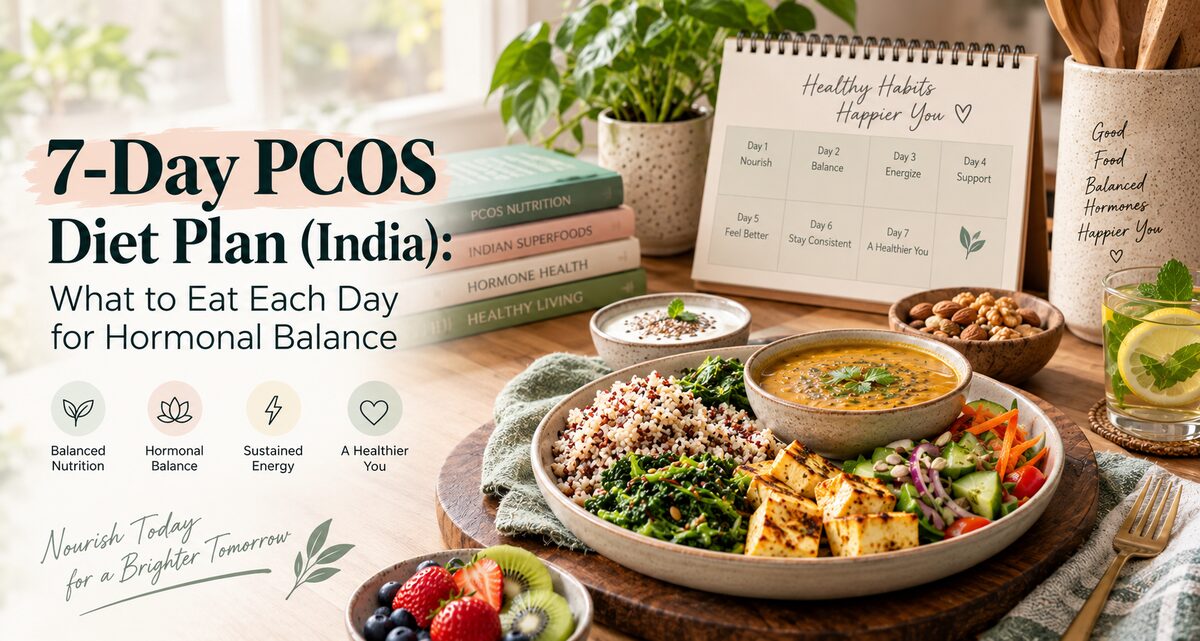
Quick answer: The best 7-day PCOS diet plan is a low-glycemic-index, protein-forward Indian eating pattern — millets, dals, vegetables, curd, and controlled grain portions — built around a simple plate ratio rather than a restrictive food list. It targets insulin resistance, the actual root cause behind most PCOS symptoms, and works better as a repeatable weekly pattern than a one-time fix.
Why PCOS needs a different approach to diet
Most generic diet advice assumes your body handles food the same way everyone else's does. If you have PCOS, it often doesn't — and that's not a personal failing, it's biology.
In a large share of PCOS cases, cells stop responding properly to insulin, the hormone that moves sugar out of your blood and into your cells for energy. When that signal weakens, your body compensates by producing more insulin. That extra insulin does two unhelpful things: it pushes your ovaries to produce more androgens (hormones linked to irregular cycles, acne, and excess hair), and it makes your body hold onto fat more stubbornly, especially around the waist.
This is why insulin-sensitising support — through diet, and in some cases through a supplement built around 40:1 myo-inositol — works on the actual root cause rather than just symptoms. This mechanism is well-documented in clinical research on the myo:D-chiro inositol ratio (Nordio M et al., Eur. Rev. Med. Pharmacol. Sci., 2019).
Food is one of the most direct levers on this loop, because every meal either spikes insulin sharply or keeps it steady. That's the entire logic behind this 7-day PCOS diet plan — not eliminating entire food groups, but choosing combinations that don't force your body into that extra-insulin response over and over again. If weight is your main concern rather than cycles or skin, this same insulin-first logic is exactly what we cover in more depth in our guide to PCOS and metabolic health.
Build your plate: a simple framework before you follow any chart
Before jumping into day-by-day meals, it helps to understand the pattern behind them, so you can build your own meals on days you deviate from the plan. A reliable way to structure each meal, without counting a single calorie:
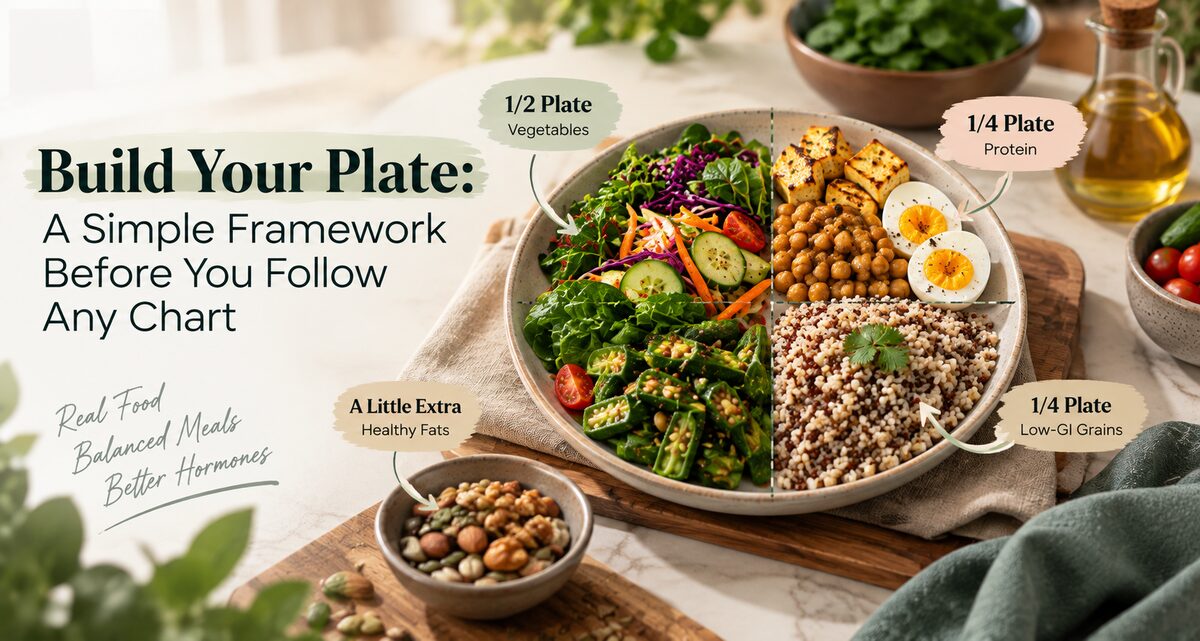
Half your plate
Vegetables — palak, lauki, bhindi, cabbage, or a mixed salad
A quarter
Protein — dal, curd, paneer, eggs, chicken, or fish
A quarter
A low-GI grain — ragi, jowar, bajra, or a controlled portion of brown rice
A small finish
Healthy fat — a few nuts, seeds, or a spoon of ghee
This plate method is the backbone of most Indian diet for PCOS recommendations you'll see from dietitians, because it's realistic for a home kitchen and doesn't require special ingredients. A small serving of nuts, seeds, or ghee also brings in magnesium, a mineral tied to insulin signalling — worth paying attention to if you consistently fall short of it through food alone, which is where something like Mag Absorb Pro can fit as a supporting habit. Building meals around fibre-forward vegetables also supports the gut-liver axis that helps process hormones and metabolic waste, an area Liver Biome Plus is formulated around, for anyone dealing with sluggish digestion alongside PCOS symptoms.
Once this ratio becomes second nature, the specific 7-day PCOS diet plan below becomes far easier to follow — and far easier to repeat in week two, three, and beyond.
The 7-day Indian PCOS diet plan
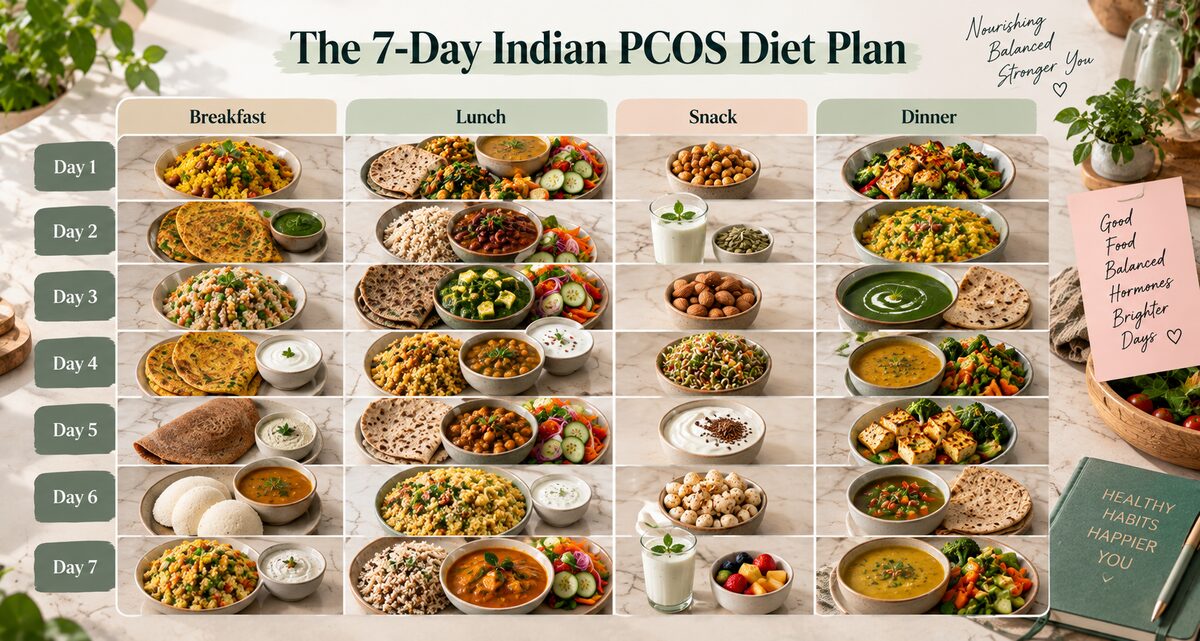
This is a vegetarian-default PCOS diet chart, with simple non-veg swaps noted for lunch or dinner wherever they fit naturally. Portions are indicative — a katori is roughly one small bowl. Adjust quantity, not food quality, based on your activity level and any guidance from your dietitian.
| Day | Breakfast | Lunch | Snack | Dinner |
|---|---|---|---|---|
| Day 1 | Vegetable poha with peanuts | Jowar roti + dal + mixed sabzi + salad | Roasted chana | Paneer/grilled chicken with sautéed vegetables |
| Day 2 | Moong dal chilla with mint chutney | Brown rice (half cup) + rajma + cucumber salad | Buttermilk + roasted seeds | Vegetable khichdi |
| Day 3 | Vegetable oats upma | Bajra roti + palak paneer/fish curry + salad | Handful of almonds | Palak soup + multigrain roti |
| Day 4 | Besan chilla + curd | Millet pulao + chana dal + raita | Sprouts chaat | Dal + sautéed seasonal vegetables |
| Day 5 | Ragi dosa + coconut chutney | Roti + chickpea curry/egg curry + salad | Greek yogurt + flaxseed | Grilled tofu/paneer with vegetables |
| Day 6 | Idli + sambar + mint chutney | Quinoa or millet khichdi + curd | Roasted makhana | Vegetable soup + roti |
| Day 7 | Vegetable upma + curd | Brown rice + fish curry/chana masala + salad | Buttermilk + fruit | Light moong dal + steamed vegetables |
A few notes to keep this 7-day PCOS diet plan realistic rather than rigid:
- Swap any day for another — none of these are sequence-dependent.
- Keep white rice portions small (half a cup) and always paired with dal or vegetables, never alone.
- One flexible or treat meal a week is fine — consistency across months matters more than a perfect week.
- If you're following this as a PCOS diet plan for weight loss, keep portion sizes moderate rather than cutting entire meals; skipping meals tends to backfire on insulin stability.
What to eat in PCOS — and what to limit
Knowing what to eat in PCOS matters more than memorising a rigid do-not-eat list, but a few categories are genuinely worth limiting.
Foods to eat more of
- Whole millets — ragi, jowar, bajra
- Dals and legumes — moong, chana, rajma, masoor
- Non-starchy vegetables — palak, lauki, bhindi, cabbage, capsicum
- Curd and buttermilk
- Nuts and seeds in moderate portions
- Fruit with skin, eaten whole rather than juiced
PCOS diet foods to avoid or limit
- Refined white flour (maida) — biscuits, white bread, most bakery items
- Sugary beverages and packaged fruit juices
- Deep-fried snacks as a daily habit
- Large portions of white rice eaten alone
- Highly processed packaged foods with long ingredient lists
None of this needs to be absolute. A PCOD diet plan that bans every treat food usually fails within a month — the goal is shifting your everyday baseline, not achieving perfection.
Where supplements fit alongside this plan
This 7-day PCOS diet plan is built around the same principle research consistently points to for PCOS: improving insulin sensitivity through food choices, meal timing, and consistent habits. Some women choose to pair this kind of eating pattern with a targeted supplement — most commonly myo-inositol combined with D-chiro-inositol in the 40:1 ratio studied in PCOS trials — since diet and inositol work on the same insulin-sensitivity pathway rather than separate ones.
It's worth being clear-eyed here: a supplement is not a substitute for the food choices above, and any supplement decision is worth a quick conversation with your doctor, particularly if you're managing PCOS alongside another condition or medication. If you're comparing options, look for a women's wellbeing supplement that discloses its exact inositol ratio and dose rather than hiding behind a proprietary blend label. If you're curious about the mechanism and dosing behind the 40:1 ratio, our dedicated guide on inositol for PCOS breaks it down in detail.
Beyond diet: two more levers worth knowing
Diet alone rarely does all the work in PCOS, and being honest about that upfront saves frustration later.
Movement: Around 150–300 minutes of moderate activity a week, plus some strength training, helps your muscles use up blood sugar more efficiently — which directly supports the same insulin-sensitivity goal as this diet plan.
Sleep: Even a few nights of poor sleep measurably reduces insulin sensitivity. A consistent sleep schedule is a free, often-overlooked lever alongside any Indian diet for PCOS.
Neither replaces the meal plan above — they simply make it work harder for you.
The bottom line
A good 7-day PCOS diet plan isn't about restriction — it's about building a repeatable weekly pattern that keeps insulin steady, uses real Indian foods, and doesn't require you to overhaul your kitchen. Pair it with consistent movement and sleep, and give it a genuine 8–12 weeks before judging results. Small, sustainable changes, followed consistently, tend to outperform any short-term perfect week.
Frequently asked questions
Is this 7-day PCOS diet plan suitable for PCOD as well?
Yes. PCOS and PCOD are used interchangeably in India, and the same insulin-focused, low-GI eating pattern applies to both, regardless of which term your report uses.
Can I follow this PCOS diet plan if I'm a non-vegetarian?
Yes — swap the vegetarian protein in any lunch or dinner (paneer, dal, tofu) for egg, chicken, or fish in a similar portion, as shown in the meal table above. The rest of the plate structure stays the same.
Do I need to cut rice completely on a PCOS diet?
No. Keep white rice to around half a cup, always paired with dal or vegetables rather than eaten alone, and prefer brown rice or millets like ragi and jowar when you can.
Can I eat fruits on a PCOS diet plan?
Yes, whole fruits with their skin — apple, guava, orange, pomegranate — are encouraged, since the fibre slows sugar absorption. Fruit juices are the exception to limit, as juicing removes the fibre and spikes blood sugar faster.
Is intermittent fasting good for PCOS?
It can help some women by improving insulin sensitivity, but it isn't necessary for this plan to work, and long fasting windows can backfire by increasing cortisol and cravings in others. It's worth trying only under guidance from your doctor or dietitian, not as a default addition.
How long before I see results from a 7-day PCOS diet plan?
Most women following a consistent low-GI, protein-forward pattern notice changes in energy and cravings within a few weeks, with cycle regularity typically improving around 8–12 weeks. Results depend on consistency more than any single perfect day.
Does dairy make PCOS worse?
Current evidence doesn't support cutting dairy for PCOS in general — curd and buttermilk fit well into a low-GI Indian plate and add useful protein. If a specific dairy food personally triggers skin or digestive issues for you, it's fine to reduce that one food rather than dairy as a whole category.
Can I repeat this 7-day PCOS diet plan every week?
Yes — it's designed as a rotating weekly pattern, not a one-time challenge. Swap individual meals for variety while keeping the same plate proportions.
Is a PCOS diet plan for weight loss different from this one?
It overlaps heavily, since both target the same insulin resistance, but weight loss specifically may need modest portion awareness layered on top of this pattern rather than a different food list. This plan is the foundation either way.
Can diet alone regularize periods in PCOS, or is medication also needed?
For many women, consistent low-GI eating alongside movement and sleep meaningfully improves cycle regularity on its own. If cycles, weight, or symptoms haven't shifted after a genuine 3-month effort, that's the signal to involve a doctor rather than a sign the diet failed.
The formulation behind this article
Ova Balance
40:1 Myo:D-Chiro inositol with Berberine HCl & Quatrefolic®
Vitamin D3 (Cholecalciferol)
600 IU (15 mcg)Form used: Vitamin D3 (cholecalciferol)
Ova Balance provides 600 IU (15 mcg) of vitamin D3 per sachet. Vitamin D supports calcium absorption and normal bone, muscle and immune function. The cited trial studied vitamin D status at a different dose; it does not establish finished-product PCOS or fertility benefits.
Myo-Inositol
2000 mgForm used: Pharmaceutical-grade myo-inositol powder, dosed in a 40:1 ratio with D-chiro inositol
Restores insulin signalling, ovulation and cycle regularity, backed by the research-backed 40:1 Myo:D-Chiro ratio.
D-Chiro Inositol
50 mgForm used: D-chiro inositol, dosed at 50 mg to hold the 40:1 ratio with myo-inositol
The original PCOS breakthrough, improves insulin sensitivity, androgen balance and ovulation when paired with myo-inositol in the 40:1 ratio.
Quatrefolic® (L-5-MTHF)
400 mcgForm used: Quatrefolic® (6S)-5-MTHF glucosamine salt, 400 mcg DFE
Patented (6S)-5-methyltetrahydrofolate glucosamine salt, the active, body-ready form of folate. Bypasses the MTHFR conversion step, so it works for everyone (including the ~30-50% with C677T variants). Delivered at 400 mcg DFE per sachet.
Berberine HCl
300 mgForm used: Berberine hydrochloride (HCl), 300 mg
Plant alkaloid that helps support insulin sensitivity, lipid balance and metabolic health, delivered at the 300 mg dose used in published PCOS and metabolic trials.
Food supplement, not a medicine. Ingredient research describes individual actives and their delivery forms, not finished-product outcomes. Consult a clinician if pregnant, lactating or on prescription medication.
Educational only. This article does not diagnose or treat PCOS. Speak with a qualified clinician or dietitian before making major dietary changes or starting a supplement, especially if you are pregnant, breastfeeding, or taking prescription medication.