
Clinical Library · Hormonal Health
PCOS is more than an irregular period
Even when your glucose looks normal, PCOS can be a reason to keep an eye on your metabolic health.

PCOS is often first noticed through the calendar.
A late period. A missed period. Another month of wondering what your body is doing.
But your cycle is not the only part of the picture. PCOS can also be linked with changes in how the body responds to insulin and manages glucose, sometimes before routine tests show prediabetes.
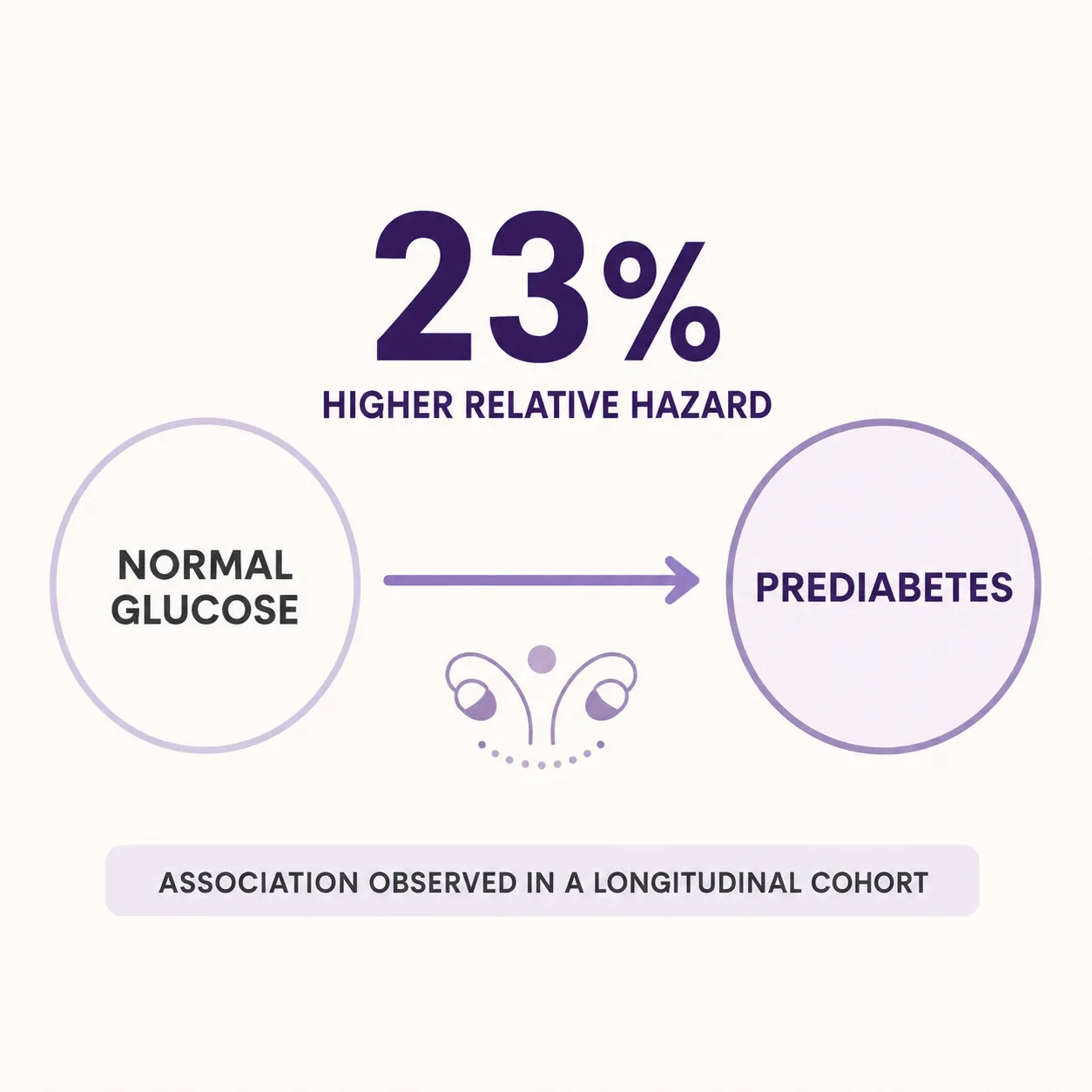
A long-term population study offers a measured reason to stay informed: among women who began with normal glucose levels, those with PCOS had a 23% higher relative hazard of progressing to prediabetes than women without PCOS.
That figure does not mean diabetes is inevitable, and it does not predict what will happen to you personally. It suggests that, for some women with PCOS, the earliest metabolic change may be a shift from normal glucose regulation to prediabetes, making regular, appropriate screening worth discussing even when your latest result was normal.
What the study actually found
Researchers followed a population-based cohort of 1,587 Iranian women across six follow-up assessments, roughly three years apart.
They examined how women moved between three glycaemic states:
- Normal glucose regulation
- Prediabetes
- Type 2 diabetes
PCOS was associated with a 23% higher hazard of moving from normal glucose regulation to prediabetes. However, PCOS did not significantly predict a direct transition from normal glucose to type 2 diabetes, or progression from prediabetes to type 2 diabetes.
This is an important distinction. The study does not say that every woman with PCOS will develop diabetes. It suggests that the earliest metabolic shift, from normal glucose to prediabetes, may be where the added risk first becomes visible. And that is precisely why the finding matters: prediabetes is not the final chapter. It is an early signal.
What “23% higher hazard” does, and does not, mean
It does not mean that 23 out of every 100 women with PCOS will develop prediabetes. It is a relative comparison between women with and without PCOS over the study period. Your personal risk still depends on factors such as age, family history, body composition, pregnancy history, sleep, activity, medicines and other metabolic conditions.
Because this was an observational study, it can identify an association but cannot prove that PCOS itself caused the progression. The cohort was also Iranian, so the exact risk estimate may not transfer unchanged to Indian women or other populations. Residual confounding remains possible.
The responsible conclusion is not panic. It is earlier attention.
Why PCOS and blood sugar are connected
Insulin is the signal that helps move glucose from the bloodstream into cells, where it can be used for energy.
In many women with PCOS, the body becomes less responsive to that signal. The pancreas may compensate by producing more insulin. For a while, glucose can still appear normal, even while the body is working harder to keep it there.
Higher insulin levels can also interact with ovarian hormone production and may contribute to features such as irregular ovulation and androgen excess. This is one reason PCOS is now understood as more than a reproductive condition. The World Health Organization describes it as a chronic metabolic condition that can continue beyond the reproductive years.
Normal fasting glucose, therefore, is reassuring, but it is not always the whole metabolic picture.
“But I am not overweight.”
PCOS-related metabolic risk is not reserved for one body type.
Body weight can influence risk, but it is not a reliable permission slip to ignore screening. A woman can be lean, active and still have PCOS-related glucose dysregulation. The 2023 International Evidence-based PCOS Guideline recommends assessment of glycaemic status in women with PCOS regardless of BMI.
You do not need to look metabolically unwell before taking metabolic health seriously.
What should you discuss with your doctor?
If you have PCOS, ask when your glucose status was last assessed, not only whether your fasting sugar once looked normal.
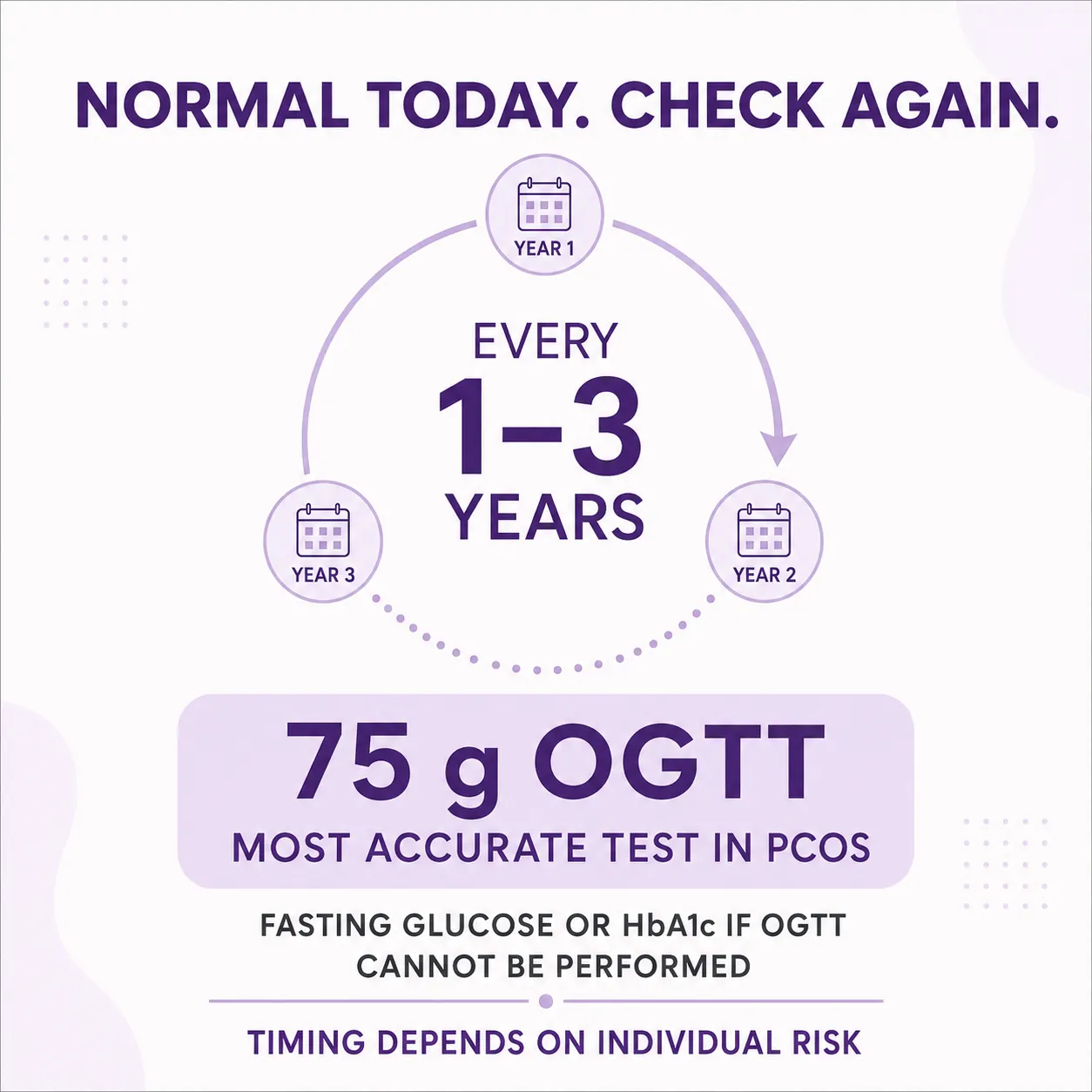
The international guideline recommends:
- Assess glycaemic status at diagnosis.
- Reassess every one to three years, depending on individual risk factors.
- Use a 75 g oral glucose tolerance test (OGTT) as the most accurate test for glycaemic assessment in PCOS, regardless of BMI.
- Consider fasting plasma glucose and/or HbA1c when an OGTT cannot be performed, recognising that they are less accurate in PCOS.
An OGTT should also be discussed when planning pregnancy or fertility treatment if you have PCOS and do not already have diagnosed diabetes. Your clinician may suggest a different schedule based on family history, previous gestational diabetes, blood pressure, medicines, symptoms or earlier test results.
What can you do before a report changes colour?
Do not wait for prediabetes to make your health feel urgent.
Start with repeatable actions:
- Build meals around protein, fibre and minimally processed foods rather than chasing a perfect “PCOS diet.”
- Include regular movement, with both aerobic activity and resistance training where appropriate.
- Protect sleep; poor sleep can make appetite and glucose regulation harder.
- Avoid treating supplements as substitutes for testing, nutrition, movement or prescribed care.
- Review your results with a qualified clinician instead of interpreting one number in isolation.
The goal is not punishment, restriction or fear. It is to reduce the metabolic workload your body has been carrying quietly.
The real message of this research
PCOS is often noticed because the period is late.
But the deeper opportunity is to act before metabolic health is late too.
A normal glucose result is good news. It is not a lifetime guarantee. Regular screening gives you something far more useful than false reassurance: the chance to notice change early, while there is still room to respond.
Your body is not failing you. It may simply be asking to be read as a whole.
Ova Balance
A once-daily sachet built around the widely studied 40:1 myo-inositol to D-chiro-inositol ratio, supported by berberine HCl, active folate and essential mineral cofactors. It is daily nutritional support, not a replacement for testing or prescribed care.
Ova Balance — 40:1 inositol for PCOSFrequently asked questions
Does PCOS mean I will get diabetes?
No. In a long-term population study, women with PCOS had a 23% higher relative hazard of moving from normal glucose regulation to prediabetes. PCOS did not significantly predict a direct move to type 2 diabetes, and a relative hazard is not a personal prediction.
What does a 23% higher hazard actually mean?
It is a relative comparison between women with and without PCOS over the study period. It does not mean 23 out of 100 women with PCOS will develop prediabetes. Your own risk depends on age, family history, body composition, pregnancy history, sleep, activity, medicines and other metabolic conditions.
My fasting sugar is normal. Do I still need screening?
Discuss it with your clinician. A normal fasting glucose is reassuring but may not capture the whole metabolic picture in PCOS. The 2023 international guideline recommends assessing glycaemic status at diagnosis and reassessing every one to three years based on individual risk.
Which test is most accurate in PCOS?
The 75 g oral glucose tolerance test (OGTT) is recommended as the most accurate test for glycaemic assessment in PCOS, regardless of BMI. Fasting plasma glucose and/or HbA1c can be considered when an OGTT cannot be performed, while recognising they are less accurate in PCOS.
I am lean. Is metabolic screening still relevant?
Yes. PCOS-related glucose dysregulation is not limited to one body type, and the 2023 guideline recommends assessing glycaemic status in women with PCOS regardless of BMI.
The formulation behind this article
Ova Balance
40:1 Myo:D-Chiro inositol with Berberine HCl & Quatrefolic®
Vitamin D3 (Cholecalciferol)
600 IU (15 mcg)Form used: Vitamin D3 (cholecalciferol)
Ova Balance provides 600 IU (15 mcg) of vitamin D3 per sachet. Vitamin D supports calcium absorption and normal bone, muscle and immune function. The cited trial studied vitamin D status at a different dose; it does not establish finished-product PCOS or fertility benefits.
Myo-Inositol
2000 mgForm used: Pharmaceutical-grade myo-inositol powder, dosed in a 40:1 ratio with D-chiro inositol
Restores insulin signalling, ovulation and cycle regularity, backed by the research-backed 40:1 Myo:D-Chiro ratio.
D-Chiro Inositol
50 mgForm used: D-chiro inositol, dosed at 50 mg to hold the 40:1 ratio with myo-inositol
The original PCOS breakthrough, improves insulin sensitivity, androgen balance and ovulation when paired with myo-inositol in the 40:1 ratio.
Quatrefolic® (L-5-MTHF)
400 mcgForm used: Quatrefolic® (6S)-5-MTHF glucosamine salt, 400 mcg DFE
Patented (6S)-5-methyltetrahydrofolate glucosamine salt, the active, body-ready form of folate. Bypasses the MTHFR conversion step, so it works for everyone (including the ~30-50% with C677T variants). Delivered at 400 mcg DFE per sachet.
Berberine HCl
300 mgForm used: Berberine hydrochloride (HCl), 300 mg
Plant alkaloid that helps support insulin sensitivity, lipid balance and metabolic health, delivered at the 300 mg dose used in published PCOS and metabolic trials.
Food supplement, not a medicine. Ingredient research describes individual actives and their delivery forms, not finished-product outcomes. Consult a clinician if pregnant, lactating or on prescription medication.
Study note
The longitudinal findings discussed here come from a 2017 Fertility and Sterility paper, “Polycystic ovary syndrome is a risk factor for diabetes and prediabetes in middle-aged but not elderly women: a long-term population-based follow-up study” (DOI: 10.1016/j.fertnstert.2017.09.004). They should not be attributed to the September 2026 issue of Endocrinology, Diabetes & Metabolism, which contains a separate population-based study on anti-Müllerian hormone and metabolic-hormonal profiles.
References
- Kazemi Jaliseh H, Ramezani Tehrani F, Behboudi-Gandevani S, et al. Polycystic ovary syndrome is a risk factor for diabetes and prediabetes in middle-aged but not elderly women: a long-term population-based follow-up study. Fertility and Sterility. 2017;108(6):1078–1084.
- Teede HJ, Tay CT, Laven JJE, et al. Recommendations from the 2023 International Evidence-based Guideline for the Assessment and Management of Polycystic Ovary Syndrome. Fertility and Sterility. 2023.
- World Health Organization. Polycystic ovary syndrome. Updated 22 January 2026.
Medical disclaimer: this article is for education and is not a diagnosis or treatment plan. Speak with a qualified healthcare professional about testing and care appropriate to you.