
Clinical Library · Hormonal Health
Inositol and Hair: Can It Help With PCOS Hair Loss and Excess Hair Growth?
If you've been typing "inositol and hair" into Google at midnight, chances are you're either dealing with thinning hair on your scalp, unwanted hair on your face or chest, or both — and you're trying to figure out if a supplement everyone talks about for PCOS periods and weight actually does anything for hair. The honest answer is more nuanced than most articles let on, and that nuance is exactly what makes the difference between wasting three months on the wrong expectation and using inositol the way the evidence actually supports.

Key takeaways
- The inositol and hair connection works indirectly — through lowering androgens and improving insulin sensitivity, not by acting on hair follicles directly
- Evidence for inositol and hirsutism (excess unwanted hair) is stronger and more consistent than evidence for scalp hair loss specifically
- A controlled trial on PCOS-related hair thinning showed measurable improvement over six months, not weeks
- Inositol hair loss recovery, where it happens, tends to follow a pattern: metabolic changes first, reduced shedding around month 3, visible change later
- Inositol is not a proven direct hair-growth agent — it's a hormonal root-cause support that happens to influence hair as one of several downstream effects
This guide walks through what the research on inositol and hair actually says, where it's strong, where it's thin, and how to set a realistic timeline either way.
Why PCOS causes both hair loss and excess hair
It sounds contradictory — the same condition causing hair to thin on your scalp while growing in places you don't want it — but both come from the same root mechanism, just expressed in different tissue.
In PCOS, insulin resistance is common, meaning cells don't respond to insulin as efficiently as they should. Your body compensates by producing more insulin, and that extra insulin pushes your ovaries to produce more androgens (male hormones like testosterone). Androgens affect hair follicles differently depending on location: on your face, chin, and chest, excess androgens can trigger new hair growth (hirsutism); on your scalp, the same hormones can shrink hair follicles over time, leading to thinning (androgenetic alopecia).
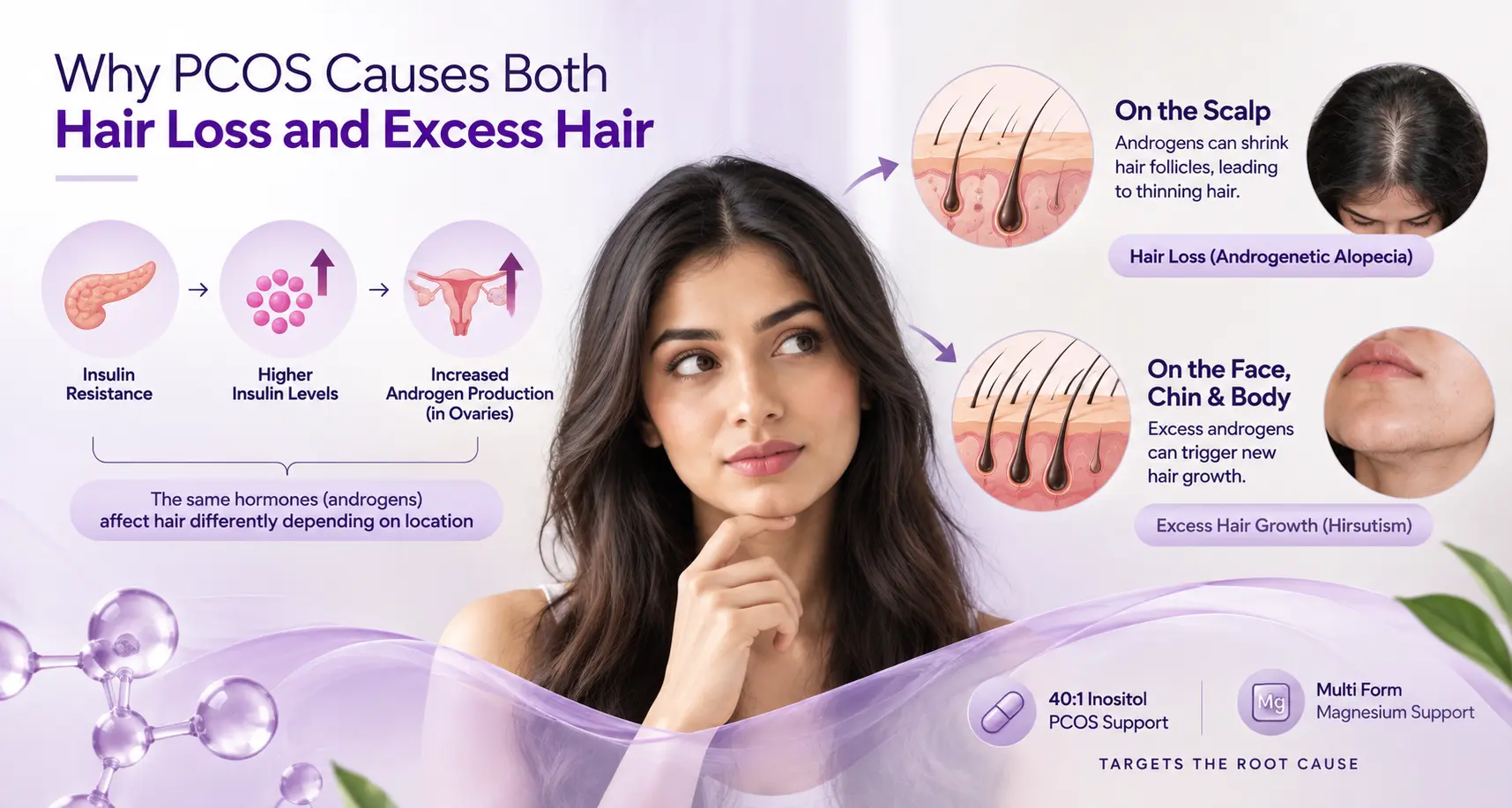
This is why insulin-sensitising support matters here too — a supplement built around a 40:1 inositol PCOS formula works on lowering androgen production at the source, rather than just addressing hair symptoms topically. Magnesium is one of the cofactors in this same insulin-signalling pathway, which is where a multi-form magnesium supplement can support the same mechanism alongside diet.
What the research actually shows: hirsutism vs. hair loss
This is the part most articles gloss over, and it matters more than any other section here.
For hirsutism, the evidence is genuinely solid. Multiple studies on myo-inositol in PCOS have shown meaningful reductions in hirsutism scores after consistent use — a 50-center Indian study of 283 women with PCOS found the proportion of patients with no hirsutism rose from 31% to over 50% after treatment with myo-inositol/D-chiro- inositol, with moderate hirsutism cases dropping sharply and no severe cases remaining post-treatment. This lines up with the broader research on inositol reducing free testosterone, which is the hormone most directly responsible for unwanted hair growth.
For scalp hair loss, the evidence is thinner — worth knowing before you set expectations. A preliminary clinical study specifically investigated inositol's effect on female androgenetic alopecia in PCOS patients, tracking hormonal changes alongside hair outcomes over several months of myo-inositol treatment. It's one of the few studies to look at inositol's impact on hair loss directly, rather than inferring it from hirsutism or testosterone data, and the results were encouraging but preliminary. Results showed improvement, but the overall body of direct research on inositol regrowing scalp hair is still small compared to what exists for hirsutism or cycle regularity. If a product or article claims inositol will "regrow your hair," that's overstating what the current data actually supports.
It's also worth knowing that the liver plays a role in metabolising and clearing excess androgens from the body, which is part of why liver function is sometimes discussed alongside hormonal conditions like PCOS — a NAC and silymarin liver formula supports that clearance pathway, though it isn't a targeted hair-loss treatment on its own.
Other causes of hair loss worth ruling out first
Before you pin every hair concern on PCOS and reach for inositol, it's worth ruling out a few other common causes — because if one of these is the actual driver, inositol won't be the fix.
- Thyroid imbalance — both an underactive and overactive thyroid can cause diffuse hair thinning, and thyroid issues are common enough in women that they're worth a simple blood test before assuming PCOS is the sole cause
- Iron deficiency — low ferritin (iron stores) is one of the most common, and most overlooked, causes of hair shedding in Indian women specifically, independent of any hormonal condition
- Vitamin D deficiency — also common in PCOS, and separately linked to hair thinning on its own
- Postpartum or medication-related shedding — telogen effluvium after childbirth, illness, or certain medications looks similar to androgen-related thinning but resolves differently
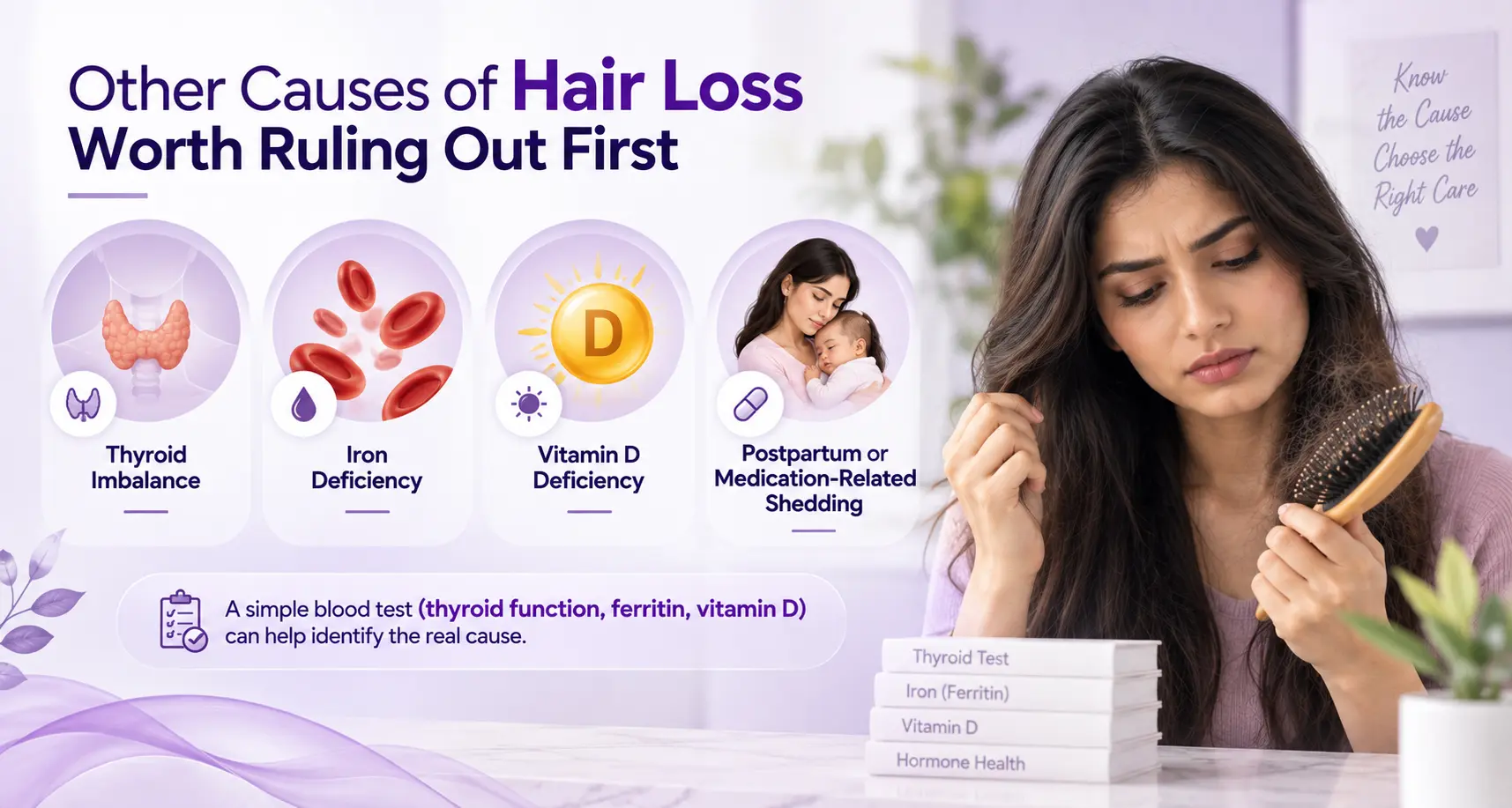
A basic panel — thyroid function, ferritin, vitamin D — is a reasonable first step alongside any inositol and hair conversation with your doctor, since treating PCOS alone won't help hair loss that's actually driven by one of these other factors.
A realistic timeline for inositol and hair changes
Patience matters here more than almost anywhere else in PCOS management, because hair changes are slower to show than cycle or energy changes.
Weeks 1–4
Insulin sensitivity begins improving at a cellular level; no visible hair change yet.
Around Month 3
Many women report reduced daily shedding — less hair in the brush or shower drain.
Months 3–6
Hirsutism scores typically show the clearest improvement in this window.
Months 6+
Any scalp regrowth, where it occurs, tends to become visible in this later stage, if at all.
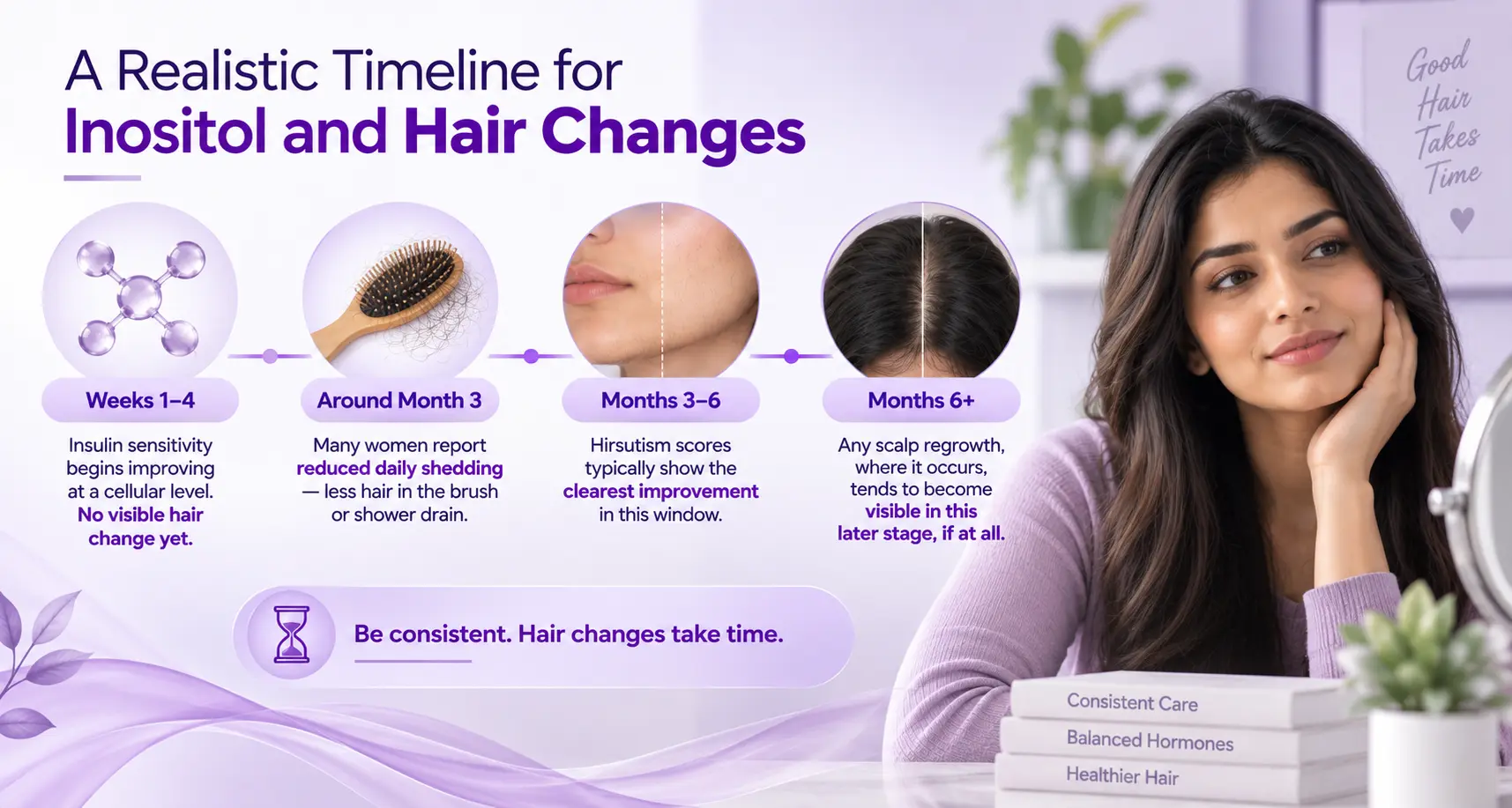
If you've been on inositol for two or three weeks and see nothing, that's not a sign it isn't working — it's simply too early for hair, specifically, to reflect internal hormonal changes.
Does inositol cause hair loss?
A fair question, since some people search this out of worry rather than hope. There's no credible evidence that inositol itself causes hair loss. The confusion usually comes from timing: starting any new supplement or hormonal shift can coincide with unrelated shedding cycles, or with the natural fluctuation some women already experience with PCOS. If anything, the research points the opposite direction — inositol's effect on androgens is more commonly linked to reduced excess-hair symptoms over time, not new hair loss.
Other nutrients that support hair alongside inositol
Inositol rarely works in isolation, and a few other nutrients are worth knowing about if hair is your primary concern:
- Zinc — supports follicle strength and plays a role in reducing inflammation around hair follicles
- Magnesium — a cofactor in the same insulin-signalling pathway inositol supports, and linked to calmer cortisol regulation, which indirectly affects hair health
- B-vitamins — support general hair growth and repair processes, though they don't address the hormonal root cause the way inositol does
- Selenium — works alongside zinc in reducing follicle-level inflammation
None of these replace addressing the underlying androgen/insulin picture — they support it. Think of inositol as working on the hormonal cause, and these nutrients as supporting the follicle's ability to respond once that hormonal environment improves. This is also why most well-formulated inositol and hair protocols pair the core inositol dose with a handful of these cofactors, rather than relying on inositol alone.
Where the 40:1 ratio fits
If you're considering a supplement specifically for the inositol-and-hair connection, the ratio and dose matter more than the word "inositol" on a label. Most of the meaningful PCOS research — for hirsutism and, to a lesser extent, hair loss — uses myo-inositol combined with D-chiro-inositol in a 40:1 ratio, mirroring the natural ratio found in a healthy ovarian follicle. TruWe's Ova Balance is formulated around this same ratio, alongside berberine and supporting cofactors, for the same insulin-sensitivity mechanism discussed throughout this article.
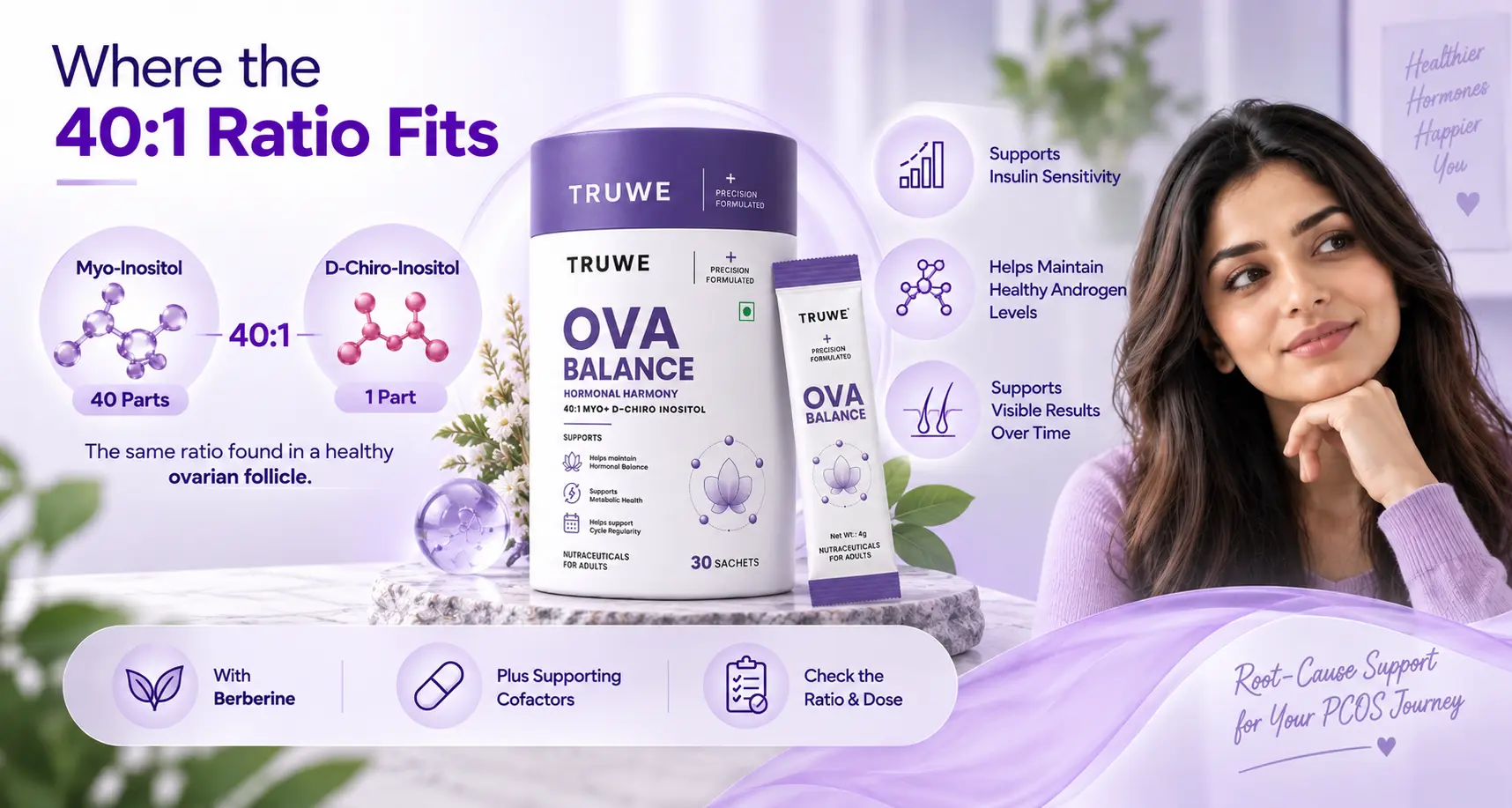
To be clear about what this can and can't promise: this is root-cause hormonal support, not a direct hair-growth treatment, and the timeline above applies here too — three to six months of consistent use before drawing conclusions, not three weeks. If you're comparing products for this specific purpose, the same rule from our other guides applies: check that the label discloses the actual ratio and milligram dose, rather than listing "inositol" as a single vague line item, since the dose used in the hirsutism and hair research is specific, not arbitrary.
Setting expectations before you start
One last honest note on inositol and hair, because expectation-setting is half of what makes any PCOS protocol feel successful or disappointing. This isn't a spot-treatment you apply to your scalp or chin — it's a systemic, hormonal intervention that happens to show up in hair as one of several downstream effects, alongside cycle regularity, skin, and energy. Track it the way you'd track any hormonal change: monthly, not daily, and alongside the other symptoms it's working on simultaneously.
Frequently asked questions
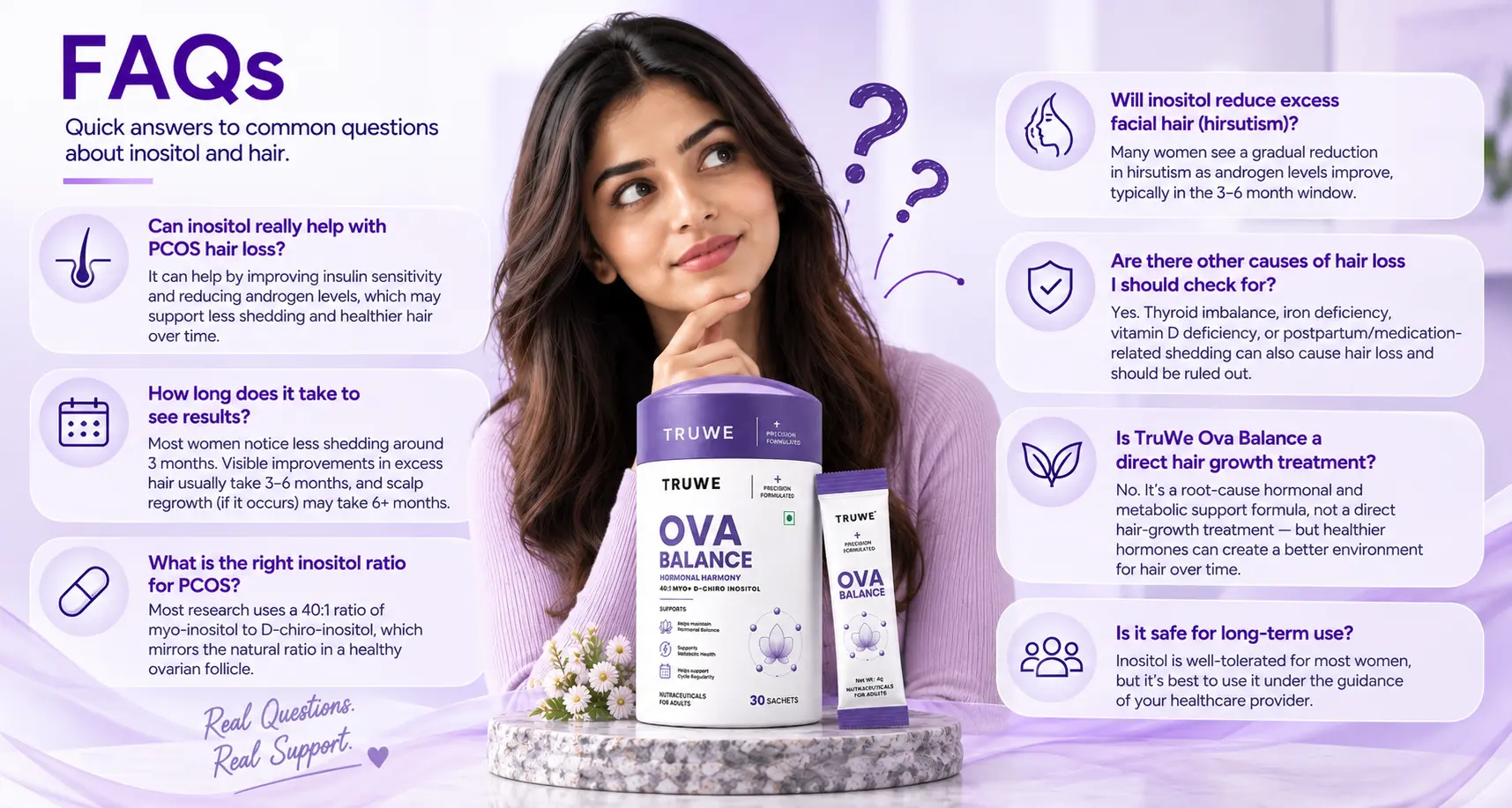
Does inositol help with PCOS hair loss?
It may help indirectly, by lowering androgens and improving insulin sensitivity — two of the main drivers of PCOS-related hair thinning. Direct evidence for scalp regrowth specifically is thinner than for other PCOS symptoms, so realistic timelines run 3–6 months, not weeks.
Does inositol help with hirsutism (excess hair growth)?
Yes — this is the area with the strongest evidence. Multiple studies show meaningfully reduced hirsutism scores in women with PCOS after consistent myo-inositol use over several months.
How long does inositol take to work for hair?
Most women don't notice visible hair changes before month 3, with reduced shedding typically reported around that point and hirsutism improvements becoming clearer between months 3 and 6. Inositol works on the hormonal cause first, and hair reflects that change later.
Can inositol cause hair loss?
No credible evidence supports this. Hair shedding noticed after starting inositol is more likely coincidental timing — overlapping with an unrelated shedding cycle — than a direct effect of the supplement.
Is inositol better for hair loss or excess facial hair?
Based on current research, hirsutism (excess unwanted hair) has more consistent supporting evidence than scalp hair loss specifically, since most PCOS inositol trials measured hirsutism scores rather than scalp density.
What ratio of inositol is used in hair-related PCOS studies?
Most research uses myo-inositol to D-chiro-inositol in a 40:1 ratio, often alongside folic acid — the same ratio naturally found in a healthy ovarian follicle, and the dose most PCOS supplements are now built around.
Can I take inositol for hair loss if I don't have PCOS?
The research on inositol and hair is specifically in PCOS populations, where excess androgens are the driving factor. If you don't have PCOS or a similar androgen-driven condition, there's little evidence inositol would meaningfully affect hair loss, so it's worth identifying the actual cause first.
Should I get blood tests before trying inositol for hair loss?
Yes — thyroid function, ferritin (iron stores), and vitamin D are worth ruling out first, since all three commonly cause hair thinning independent of PCOS. Treating PCOS with inositol won't help hair loss that's actually driven by one of these other factors.
Does inositol regrow hair completely, or just slow hair loss?
Current research doesn't support “complete regrowth” claims — the more accurate expectation is reduced shedding and, for some women, partial improvement over 3–6 months, alongside better hirsutism scores. Treat any product promising full regrowth with caution, since the evidence doesn't go that far.
What other nutrients help alongside inositol for PCOS hair loss?
Zinc, magnesium, B-vitamins, and selenium are commonly paired with inositol, supporting follicle strength and inflammation while inositol addresses the underlying hormonal driver. None of these replace inositol's role — they support the same system from different angles.
The bottom line
The relationship between inositol and hair isn't a straightforward "yes, it regrows hair" story — it's a root-cause story. By improving insulin sensitivity and lowering excess androgens, inositol addresses one of the actual drivers behind both PCOS hair loss and hirsutism, with stronger evidence for the latter. Set your timeline at months, not weeks, pair it with other supportive nutrients like magnesium and zinc, and treat any product promising overnight regrowth with healthy skepticism — the real research simply doesn't move that fast.
The formulation behind this article
Ova Balance
40:1 Myo:D-Chiro inositol with Berberine HCl & Quatrefolic®
Vitamin D3 (Cholecalciferol)
600 IU (15 mcg)Form used: Vitamin D3 (cholecalciferol)
Ova Balance provides 600 IU (15 mcg) of vitamin D3 per sachet. Vitamin D supports calcium absorption and normal bone, muscle and immune function. The cited trial studied vitamin D status at a different dose; it does not establish finished-product PCOS or fertility benefits.
Myo-Inositol
2000 mgForm used: Pharmaceutical-grade myo-inositol powder, dosed in a 40:1 ratio with D-chiro inositol
Restores insulin signalling, ovulation and cycle regularity, backed by the research-backed 40:1 Myo:D-Chiro ratio.
D-Chiro Inositol
50 mgForm used: D-chiro inositol, dosed at 50 mg to hold the 40:1 ratio with myo-inositol
The original PCOS breakthrough, improves insulin sensitivity, androgen balance and ovulation when paired with myo-inositol in the 40:1 ratio.
Quatrefolic® (L-5-MTHF)
400 mcgForm used: Quatrefolic® (6S)-5-MTHF glucosamine salt, 400 mcg DFE
Patented (6S)-5-methyltetrahydrofolate glucosamine salt, the active, body-ready form of folate. Bypasses the MTHFR conversion step, so it works for everyone (including the ~30-50% with C677T variants). Delivered at 400 mcg DFE per sachet.
Berberine HCl
300 mgForm used: Berberine hydrochloride (HCl), 300 mg
Plant alkaloid that helps support insulin sensitivity, lipid balance and metabolic health, delivered at the 300 mg dose used in published PCOS and metabolic trials.
Food supplement, not a medicine. Ingredient research describes individual actives and their delivery forms, not finished-product outcomes. Consult a clinician if pregnant, lactating or on prescription medication.
Educational only. This article does not diagnose or treat PCOS, hair loss or hirsutism. Speak with a qualified clinician before starting a supplement, especially if you are pregnant, breastfeeding, or taking prescription medication.