
Clinical Library · Hormonal Balance
Inositol for PCOS: How Much, When and How Long
The four questions people actually ask about inositol, answered plainly — plus a realistic timeline and what it does not do.
What the 40:1 ratio means
Inositol comes in two forms that matter here: myo-inositol and D-chiro inositol. In healthy ovarian fluid they occur together in roughly a 40 to 1 ratio, and that is the ratio the bulk of PCOS research has used — 2000 mg of myo-inositol alongside 50 mg of D-chiro inositol, once a day.
This is the single most useful thing to check before buying. A product heavy on D-chiro inositol, or one that lists a combined inositol figure without splitting it, is not following the evidence people are quoting when they recommend inositol in the first place. Our label-reading guide shows how to spot the difference in about a minute.
How to take it, practically
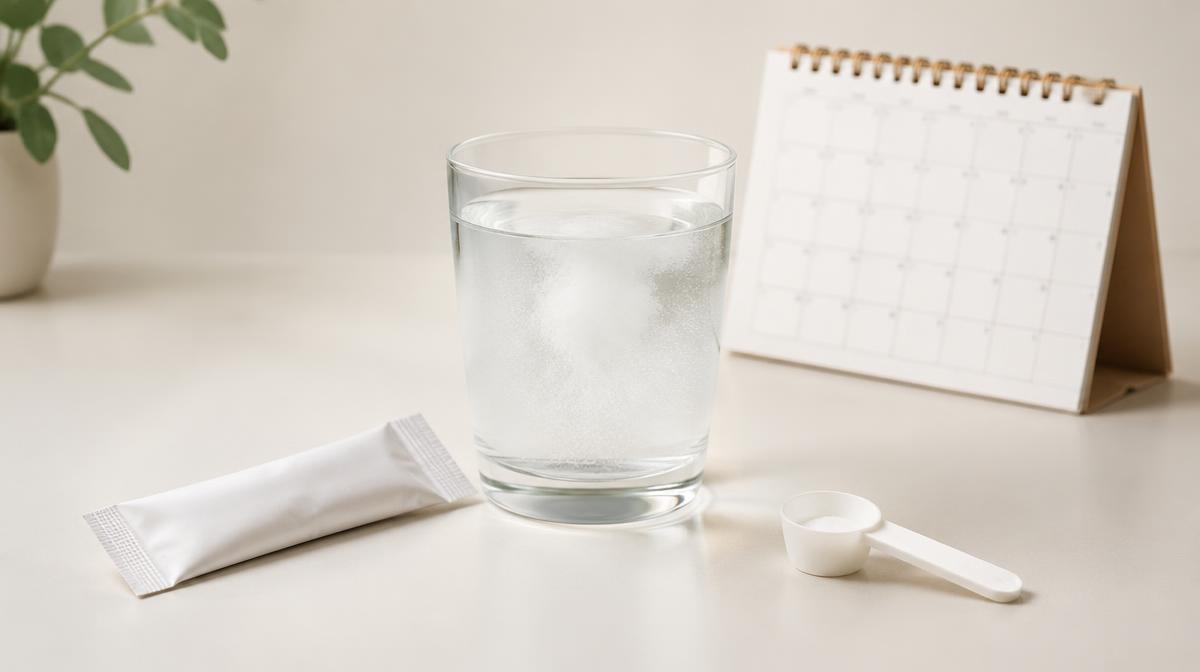
One serving stirred into plain water, at the same time every day. Not sweetened juice, which works against the metabolic point of taking it. Morning suits most people because it is easy to attach to an existing habit, but the evening is equally valid if that is what you will remember.
Missing a day is not a setback — take the next one as usual. Missing three weeks is a different matter, because consistency is the whole mechanism. The single biggest predictor of whether inositol does anything for someone is whether they actually took it daily for three months.
What to expect, week by week
Weeks 1-2
Nothing dramatic. You are building the habit. Mild digestive adjustment can happen and usually passes.
Weeks 3-6
Some people report steadier energy through the afternoon and fewer sugar cravings. Others notice nothing yet, which is normal.
Weeks 7-12
The window where cycle-related changes are typically assessed in research. Track your cycle dates so you have something real to compare.
After 3 months
Review honestly with your doctor, with your notes in hand, and decide whether to continue.
Keep a simple note of cycle start dates and how you felt each week. Without it, three months later you will be guessing — and guessing is how people abandon something that was quietly working.
What inositol does not do
- It does not diagnose or treat PCOS — that is your doctor's work
- It is not a weight loss supplement
- It does not replace prescribed medication
- It does not work on its own if sleep, nutrition and movement are ignored
Nutrition and routine alongside it
The everyday things carry more weight than most people expect with PCOS: protein at breakfast, fibre with every meal, walking after dinner, a regular sleep window, and keeping refined sugar occasional rather than routine. Good nutrition is not the background to inositol — it is the main act, and inositol supports it.
For the wider picture, our full PCOS and inositol guide and the irregular periods checklist cover diagnosis, tests and what to raise with your doctor.
Where Ova Balance fits
Ova Balance is built to the same numbers this article describes: myo-inositol 2000 mg and D-chiro inositol 50 mg at the 40:1 ratio, with berberine HCl 300 mg, Quatrefolic® L-5-MTHF 400 mcg, vitamin D3 600 IU, magnesium bisglycinate, zinc bisglycinate and chromium picolinate. One sachet a day in water.
Frequently asked questions
How much inositol should I take for PCOS?
The amount used in most PCOS research is 2000 mg of myo-inositol with 50 mg of D-chiro inositol per day — the 40:1 ratio. That is one daily serving, not a number you need to build up to.
When should I take inositol — morning or night?
Either is fine. What matters is the same time every day, stirred into plain water. Many people take it with breakfast simply because it is the easiest slot to keep.
How long does inositol take to work for PCOS?
Cycle-related changes are usually assessed over three months, because a cycle is the unit of measurement. Some people notice energy and cravings settling earlier, around weeks four to six. Three full months is the fair test.
What is the 40:1 myo to D-chiro inositol ratio?
It is the ratio in which the two forms naturally occur in healthy ovarian fluid, and the ratio used in the bulk of PCOS research. Products that skew heavily towards D-chiro inositol are not following that evidence.
Can I take inositol with food?
Yes. Water on its own is the simplest, but with a meal is perfectly acceptable, and some people find it sits better that way.
Does inositol cause side effects?
At the researched amount it is generally well tolerated. Mild nausea or loose stools can occur in the first week and usually settle. Anyone pregnant, breastfeeding or on prescription medication should ask their doctor first.
Can I take inositol alongside my prescribed medication?
That is a conversation for the doctor who prescribed it, particularly for metformin or thyroid medication. Do not stop or change a prescription on your own.
Does inositol help with weight loss?
It is not a weight loss product and should not be bought as one. It is studied for the metabolic and cycle side of PCOS, and nutrition, sleep and movement remain the levers for weight.
The formulation behind this article
Ova Balance
40:1 Myo:D-Chiro inositol with Berberine HCl & Quatrefolic®
Vitamin D3 (Cholecalciferol)
600 IU (15 mcg)Form used: Vitamin D3 (cholecalciferol)
Ova Balance provides 600 IU (15 mcg) of vitamin D3 per sachet. Vitamin D supports calcium absorption and normal bone, muscle and immune function. The cited trial studied vitamin D status at a different dose; it does not establish finished-product PCOS or fertility benefits.
Myo-Inositol
2000 mgForm used: Pharmaceutical-grade myo-inositol powder, dosed in a 40:1 ratio with D-chiro inositol
Restores insulin signalling, ovulation and cycle regularity, backed by the research-backed 40:1 Myo:D-Chiro ratio.
D-Chiro Inositol
50 mgForm used: D-chiro inositol, dosed at 50 mg to hold the 40:1 ratio with myo-inositol
The original PCOS breakthrough, improves insulin sensitivity, androgen balance and ovulation when paired with myo-inositol in the 40:1 ratio.
Quatrefolic® (L-5-MTHF)
400 mcgForm used: Quatrefolic® (6S)-5-MTHF glucosamine salt, 400 mcg DFE
Patented (6S)-5-methyltetrahydrofolate glucosamine salt, the active, body-ready form of folate. Bypasses the MTHFR conversion step, so it works for everyone (including the ~30-50% with C677T variants). Delivered at 400 mcg DFE per sachet.
Berberine HCl
300 mgForm used: Berberine hydrochloride (HCl), 300 mg
Plant alkaloid that helps support insulin sensitivity, lipid balance and metabolic health, delivered at the 300 mg dose used in published PCOS and metabolic trials.
Food supplement, not a medicine. Ingredient research describes individual actives and their delivery forms, not finished-product outcomes. Consult a clinician if pregnant, lactating or on prescription medication.
Educational only. This article does not diagnose or treat PCOS. Speak with a qualified clinician before starting a supplement, especially if you are pregnant, breastfeeding, or taking prescription medication.