
Clinical Library · Hormonal Health
PCOD vs PCOS vs PMOS: What the 2026 Name Change Means in India
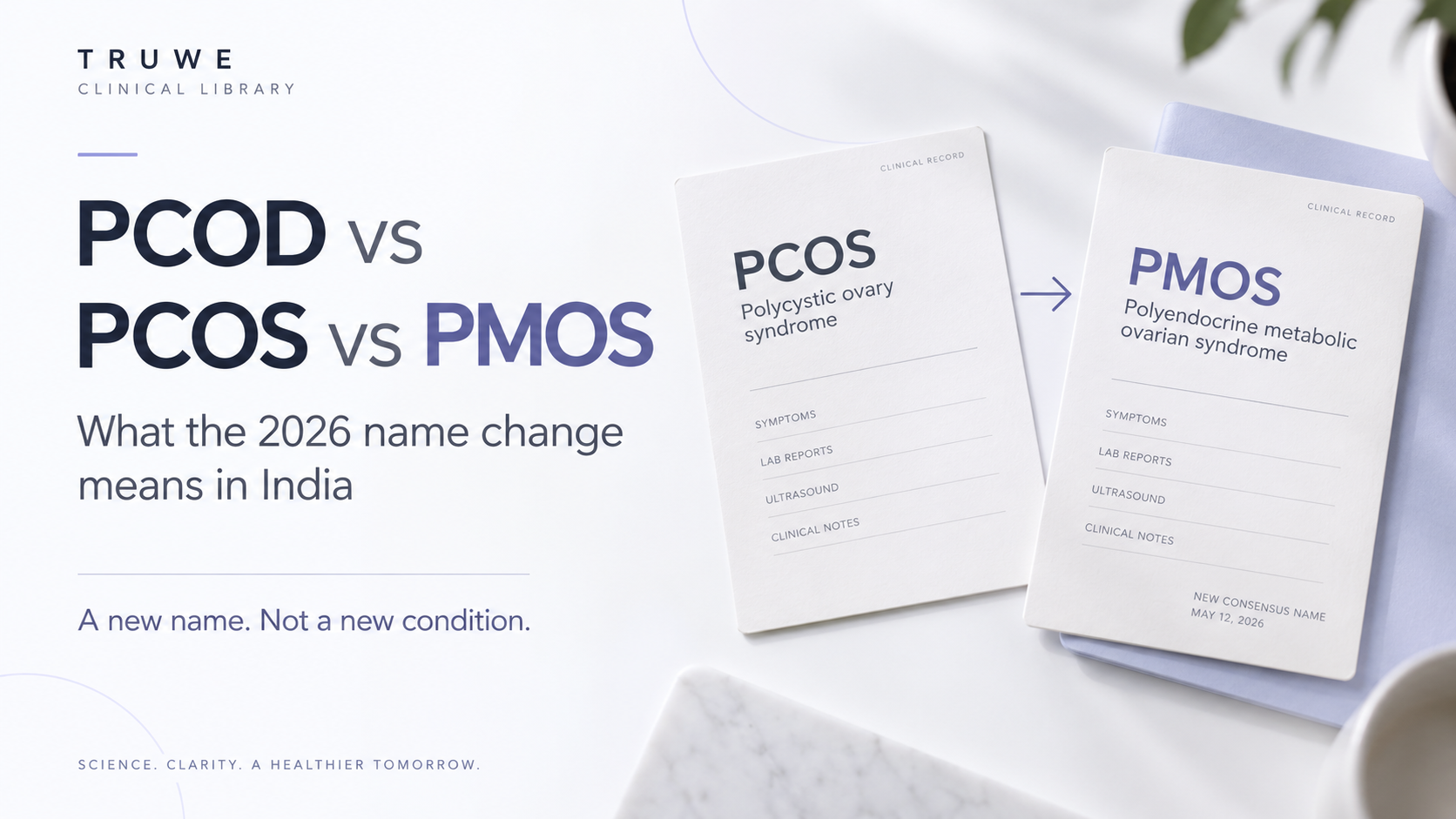
If you searched PCOS PMOS, PMOS vs PCOS, or PCOD vs PMOS, you are probably trying to work out whether a new acronym means a new illness. It does not. PMOS is the new name for the condition previously called PCOS. PCOD is a term commonly used in India, but international guidelines do not define it as a separate, milder diagnosis.
The change from PCOS to PMOS was announced in 2026 because “polycystic” can make people think ovarian cysts are the disease. They are not. The condition can involve menstrual cycles, ovulation, androgen-related symptoms, metabolism, sleep, mood and long-term health. The name changed to describe that wider picture; your body did not suddenly develop a different condition.
This guide explains what PMOS is, the PMOS full form, how PCOS and PMOS relate, what PMOS symptoms can look like, and how to read a report that says PCOD.
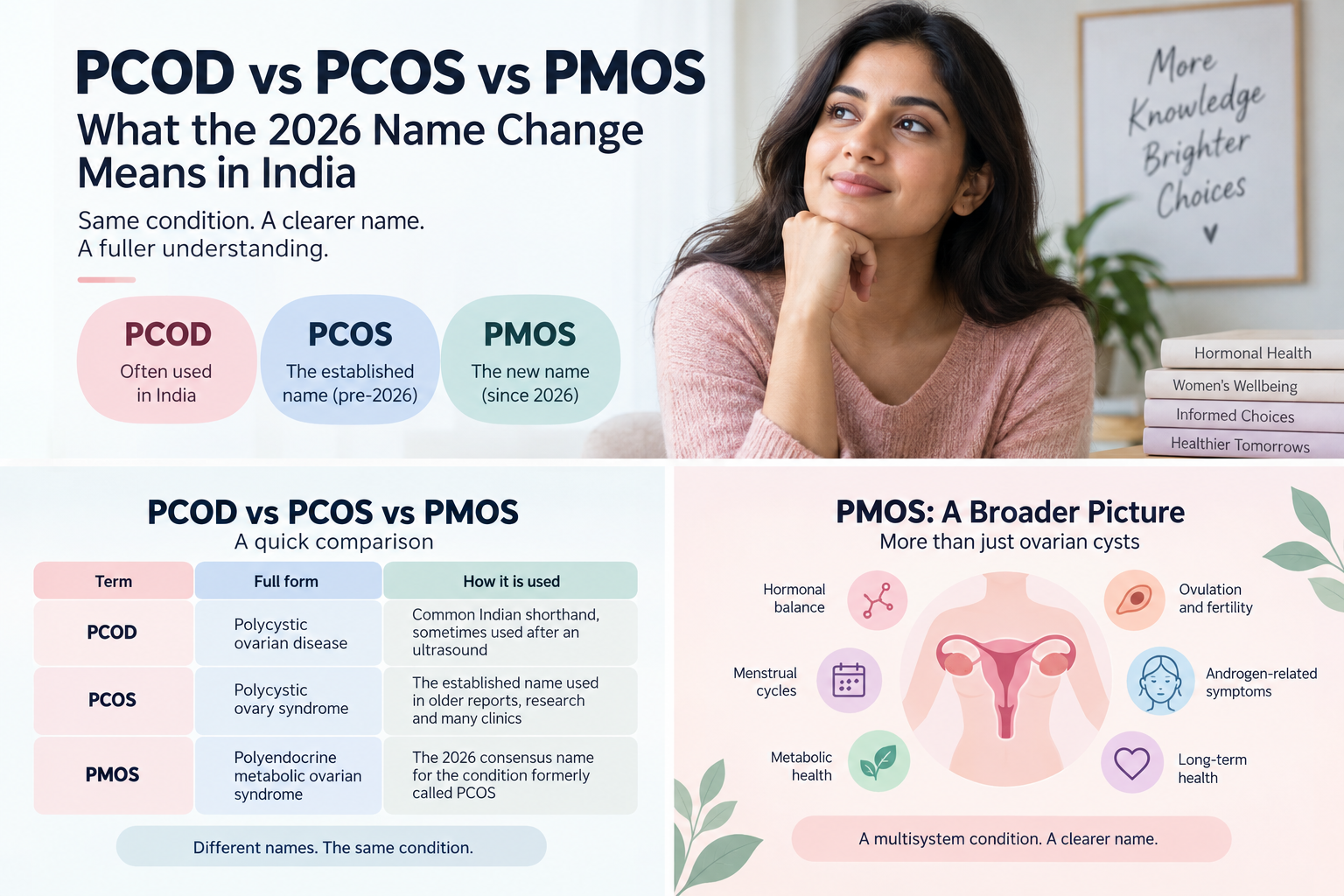
PCOD vs PCOS vs PMOS: the comparison
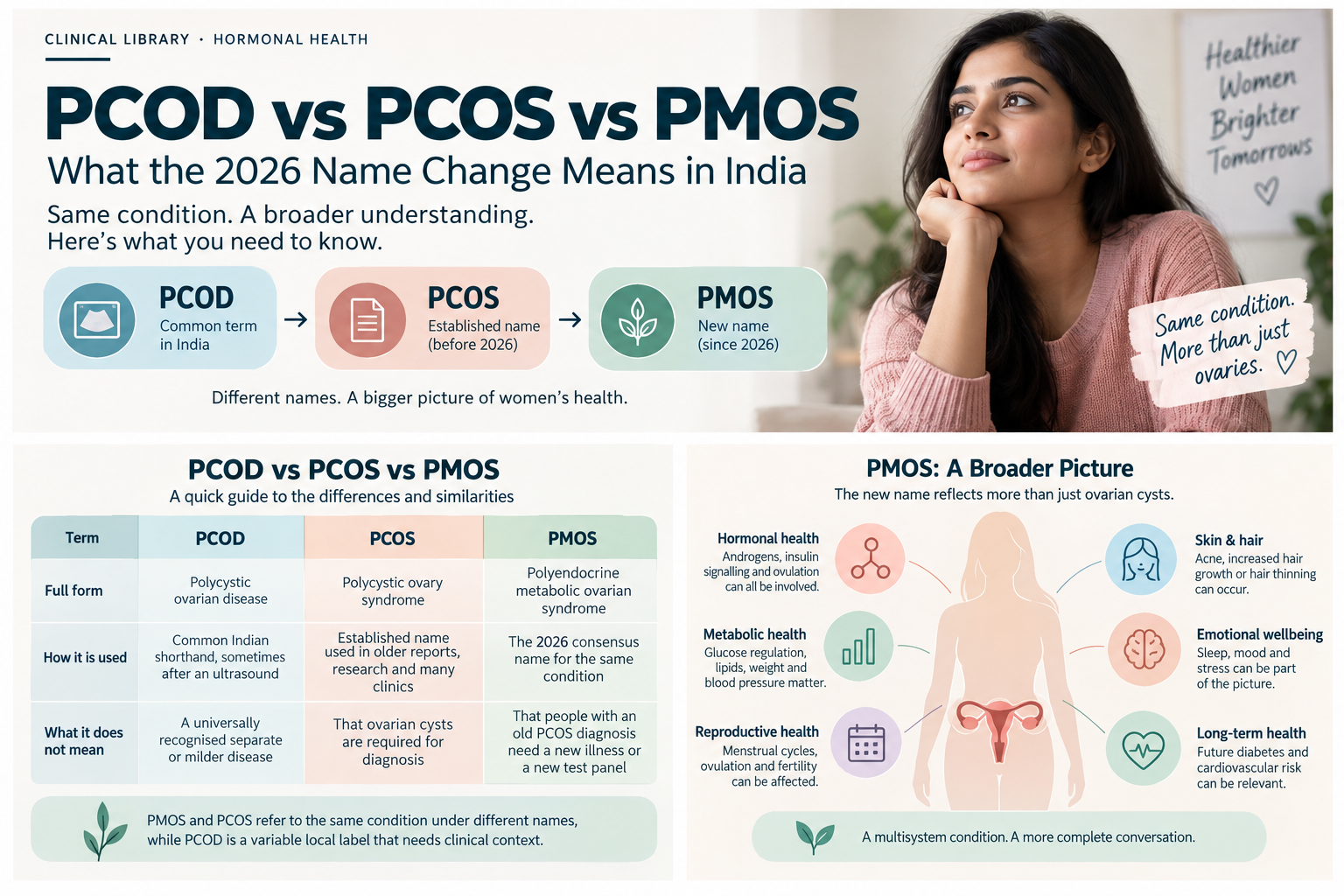
| Term | Full form | How it is used | What it does not mean |
|---|---|---|---|
| PCOD | Polycystic ovarian disease | Common Indian shorthand, sometimes used after an ultrasound | A universally recognised separate or milder disease |
| PCOS | Polycystic ovary syndrome | The established name used in older reports, research and many clinics | That ovarian cysts are required for diagnosis |
| PMOS | Polyendocrine metabolic ovarian syndrome | The 2026 consensus name for the condition formerly called PCOS | That people with an old PCOS diagnosis need a new illness or a new test panel |
What is PMOS? The PMOS full form explained
The PMOS full form is polyendocrine metabolic ovarian syndrome. Each word points to part of the condition:
- Polyendocrine signals that more than one hormone system can be involved. Androgens, insulin signalling and the hormones that coordinate ovulation may interact in different ways between people.
- Metabolic recognises that glucose regulation, lipids, weight, blood pressure and future diabetes risk can matter alongside cycles and fertility.
- Ovarian acknowledges ovarian and ovulatory features without suggesting that the ovaries are the only source of the problem.
The word “polycystic” was removed because the follicles seen on some scans are not the same as dangerous pathological cysts, and some people who meet the clinical criteria do not have polycystic ovarian morphology on ultrasound.
The new name does not mean every person has a problem with every endocrine gland. It is a description of a multisystem syndrome, not a claim that all hormone systems are failing.
PMOS vs PCOS: are they different?
No. PMOS vs PCOS is mainly a name comparison, not a comparison between two diseases.
The 2026 consensus process recommends a transition period so that medical records, research papers, patient information and health systems can catch up. During that transition, doctors may write PCOS, PMOS or PMOS/PCOS. An old PCOS report does not expire because a newer term is being introduced.
The diagnostic logic also remains familiar. In adults, clinicians generally look for at least two of the following after considering other causes:
- 1Irregular or absent ovulation, often seen as irregular or missed periods.
- 2Clinical or biochemical evidence of higher androgen activity, such as excess facial or body hair, acne, scalp hair thinning or a raised androgen blood test.
- 3Polycystic ovarian morphology on ultrasound; in some adult pathways, an AMH blood test may be considered instead of ultrasound.
If irregular cycles and clear androgen excess are already present, an ultrasound may not be necessary. Adolescents need a more careful assessment because normal puberty can overlap with some features and an ultrasound is not a shortcut to diagnosis.
PCOD vs PMOS in India: why reports use different words
Many Indian women first hear “PCOD” after an ultrasound. In everyday clinic language, PCOD may be used to mean:
- 1The scan shows many small follicles, with no confirmed syndrome yet; or
- 2The clinician is using a familiar local term for the condition called PCOS in international guidelines.
Those are not always the same thing. A scan is one piece of information. It should be read alongside cycle history, signs of androgen activity, blood tests, glucose or other metabolic markers, medicines, pregnancy plans and possible alternative explanations.
That is why PCOD vs PMOS cannot be answered from the words on one report. Ask the clinician what they meant by PCOD and which findings support or do not support a syndrome diagnosis.
PMOS symptoms: what can the condition look like?
There is no single list that every person with PMOS will have. Possible PMOS symptoms include:
- periods that are infrequent, unpredictable or absent;
- difficulty predicting ovulation or conceiving;
- acne or oilier skin;
- excess facial or body hair;
- scalp hair thinning;
- weight change or difficulty managing weight, although body weight is not the definition;
- insulin resistance, prediabetes or changes in glucose regulation;
- high blood pressure or an unfavourable lipid profile;
- sleep problems, anxiety, depression or a negative body image.
These symptoms have many possible causes. They are reasons to seek an appropriate assessment, not a self-diagnosis checklist.
The World Health Organization estimates that PCOS affects about 10–13% of women of reproductive age and that many people remain undiagnosed. It also describes PCOS as a chronic metabolic condition associated with longer-term risks including type 2 diabetes, high blood pressure, cardiovascular disease, sleep apnoea and endometrial problems. Risk is not destiny, and the right assessment depends on the person and life stage.
PCOS and PMOS: what actually changed in 2026?
In May 2026, a global consensus paper in The Lancet described PMOS as the preferred new name for the condition previously known as PCOS. Monash University and partner organisations describe a three-year transition, with the next international guideline update expected to use PMOS as standard terminology.
The reasons for the change were practical:
- “Polycystic” can imply that ovarian cysts define the illness, which is inaccurate.
- The old name can hide metabolic, cardiovascular, psychological and dermatological features.
- A fertility-only frame can delay a fuller assessment and fragment care between specialties.
- A name that better reflects the condition may reduce confusion and stigma.
The consensus process did not announce a new cure, a new supplement or a replacement for clinical care. It changed the label and the way the condition is explained.
What did not change after the PCOS to PMOS rename?
- You still need a qualified clinician to diagnose the condition.
- A single ultrasound cannot establish the diagnosis.
- Other causes of irregular cycles or androgen-related symptoms still need to be considered. Depending on the situation, that may include pregnancy, thyroid disease, raised prolactin, non-classic congenital adrenal hyperplasia or other androgen sources.
- Healthy eating, movement, sleep and emotional wellbeing remain part of care for everyone, regardless of whether weight changes.
- Medical treatment depends on the goal: cycle protection, acne or hair symptoms, metabolic risk, fertility, or another concern.
- A person with a normal-weight body can still have the condition.
- The new letters do not justify stopping prescribed medicines or changing a fertility plan without medical advice.
What to do if a report says PCOD, PCOS or PMOS
- 1Keep the report and note the exact wording.
- 2Record cycle dates, bleeding pattern, skin or hair changes, sleep and relevant medicines for a few months if possible.
- 3Bring previous scans, hormone tests, glucose or HbA1c, lipid results and blood-pressure readings to an appointment.
- 4Ask what has been ruled out and which features support the diagnosis.
- 5Agree on one or two current goals. Cycle predictability, acne, hair, metabolic markers, fertility and mood may need different parts of a plan.
- 6Treat supplements as optional support beside clinician-led care, not as a diagnostic tool or replacement for treatment.
Seek prompt medical advice for very heavy bleeding, rapidly changing androgen-related symptoms, severe pain, possible pregnancy, or periods that stop for several months.
Where nutrition and supplements fit
Food, movement, sleep and stress support can be useful parts of a broader plan. They do not prove that a person has PMOS and they do not replace medical care.
The 2023 international guideline says inositol may be considered according to individual preferences, with possible metabolic benefit but limited clinical benefits and no universally recommended type, dose or combination. Supplement quality and dose can vary. Berberine can affect glucose and interact with medicines. Pregnancy, breastfeeding, fertility treatment and glucose-lowering medicines all warrant a clinician conversation before starting or changing a supplement.
TruWe’s Ova Balance page can be used as a product reference for readers who want to understand the formula and label. It should be presented as nutritional support for a broader routine, not as a cure, a diagnosis or a substitute for prescribed care.
From the TruWe range
Ova Balance
Explore Ova Balance ingredients and label
View productFrequently asked questions
What is PMOS?
PMOS is polyendocrine metabolic ovarian syndrome, the new name for the condition previously called PCOS.
What is the PMOS full form?
PMOS stands for polyendocrine metabolic ovarian syndrome.
Is PMOS the same as PCOS?
Yes. PMOS and PCOS refer to the same condition under the new and older names. The rename does not mean that someone with PCOS has developed a different illness.
Is PCOD the same as PMOS?
Sometimes the words are used for the same patient pattern in India, but PCOD is not a separate international diagnosis. An ultrasound finding described as PCOD needs to be interpreted with cycle history, androgen findings and other possible causes.
What are the common PMOS symptoms?
Possible symptoms include irregular or absent periods, acne, excess facial or body hair, scalp hair thinning, difficulty conceiving and metabolic risk. Not everyone has all of them, and each symptom can have other causes.
What does PCOS to PMOS mean?
It describes the 2026 transition from the older name, polycystic ovary syndrome, to the preferred name, polyendocrine metabolic ovarian syndrome. It is a terminology change for the same condition.
Can I have PMOS without cysts on an ultrasound?
Yes. Ovarian cysts are not required. In adults, the diagnosis can be based on irregular ovulation and androgen excess after other causes have been considered.
Does an ultrasound that says PCOD mean I have PMOS?
Not by itself. The scan is one part of an assessment, not a complete diagnosis.
Do I need new tests because the name changed?
Not simply because the letters changed. You may need a fuller assessment if the original visit looked only at the ovaries and did not consider cycles, androgen symptoms, glucose, lipids, blood pressure or other causes.
Is there a cure for PMOS?
There is no single cure. Symptoms and longer-term risks can often be managed with an individual plan. Claims such as “reverse PMOS in 30 days” are marketing language, not a clinical standard.
Sources
- Teede HJ, Bahri Khomami M, Morman R, et al. Polyendocrine metabolic ovarian syndrome, the new name for polycystic ovary syndrome: a multistep global consensus process. The Lancet. 2026;407(10545):2329–2339. https://doi.org/10.1016/S0140-6736(26)00717-8
- World Health Organization. Polycystic ovary syndrome. Updated 22 January 2026. https://www.who.int/news-room/fact-sheets/detail/polycystic-ovary-syndrome
- Monash Centre for Health Research and Implementation. PCOS Guideline / PMOS Guideline. https://www.monash.edu/medicine/mchri/pcos/guideline
- Teede HJ, Tay CT, Laven JJE, et al. Recommendations from the 2023 International Evidence-based Guideline for the Assessment and Management of Polycystic Ovary Syndrome. American Society for Reproductive Medicine. ASRM practice guidance
The formulation behind this article
Ova Balance
40:1 Myo:D-Chiro inositol with Berberine HCl & Quatrefolic®
Vitamin D3 (Cholecalciferol)
600 IU (15 mcg)Form used: Vitamin D3 (cholecalciferol)
Ova Balance provides 600 IU (15 mcg) of vitamin D3 per sachet. Vitamin D supports calcium absorption and normal bone, muscle and immune function. The cited trial studied vitamin D status at a different dose; it does not establish finished-product PCOS or fertility benefits.
Myo-Inositol
2000 mgForm used: Pharmaceutical-grade myo-inositol powder, dosed in a 40:1 ratio with D-chiro inositol
Restores insulin signalling, ovulation and cycle regularity, backed by the research-backed 40:1 Myo:D-Chiro ratio.
D-Chiro Inositol
50 mgForm used: D-chiro inositol, dosed at 50 mg to hold the 40:1 ratio with myo-inositol
The original PCOS breakthrough, improves insulin sensitivity, androgen balance and ovulation when paired with myo-inositol in the 40:1 ratio.
Quatrefolic® (L-5-MTHF)
400 mcgForm used: Quatrefolic® (6S)-5-MTHF glucosamine salt, 400 mcg DFE
Patented (6S)-5-methyltetrahydrofolate glucosamine salt, the active, body-ready form of folate. Bypasses the MTHFR conversion step, so it works for everyone (including the ~30-50% with C677T variants). Delivered at 400 mcg DFE per sachet.
Berberine HCl
300 mgForm used: Berberine hydrochloride (HCl), 300 mg
Plant alkaloid that helps support insulin sensitivity, lipid balance and metabolic health, delivered at the 300 mg dose used in published PCOS and metabolic trials.
Food supplement, not a medicine. Ingredient research describes individual actives and their delivery forms, not finished-product outcomes. Consult a clinician if pregnant, lactating or on prescription medication.
Medical note. This article is educational. It is not a diagnosis, treatment plan or substitute for care from a qualified clinician. Supplement decisions should sit beside appropriate medical advice, especially if you take prescription medicines, are pregnant or breastfeeding, or are planning a pregnancy.