
Clinical Library · Minerals
Magnesium vs Melatonin: Which Is Better for Sleep?

Quick answer: Melatonin tells your body it is night, so it helps most when your sleep timing is off, like jet lag or night shifts. Magnesium helps your body relax, so it suits people who feel tense at bedtime or get too little from food. Neither cures insomnia, and the better choice depends on your sleep problem.
Key takeaways
- Melatonin works on sleep timing. Magnesium works on relaxation. They are different kinds of help.
- No study has compared the two head to head, so there is no proven universal winner.
- The American Academy of Sleep Medicine does not recommend either one for insomnia.
- Both can interact with medicines, so check with your doctor first.
You are lying in bed at midnight, tired but wide awake. One friend says, "Take melatonin." Another says, "Try magnesium." The magnesium vs melatonin question comes up so often because both are easy to buy and both sound gentle. But they work in very different ways. This guide explains how each one works, what the research really says, and how to choose without guesswork.
Magnesium vs melatonin at a glance
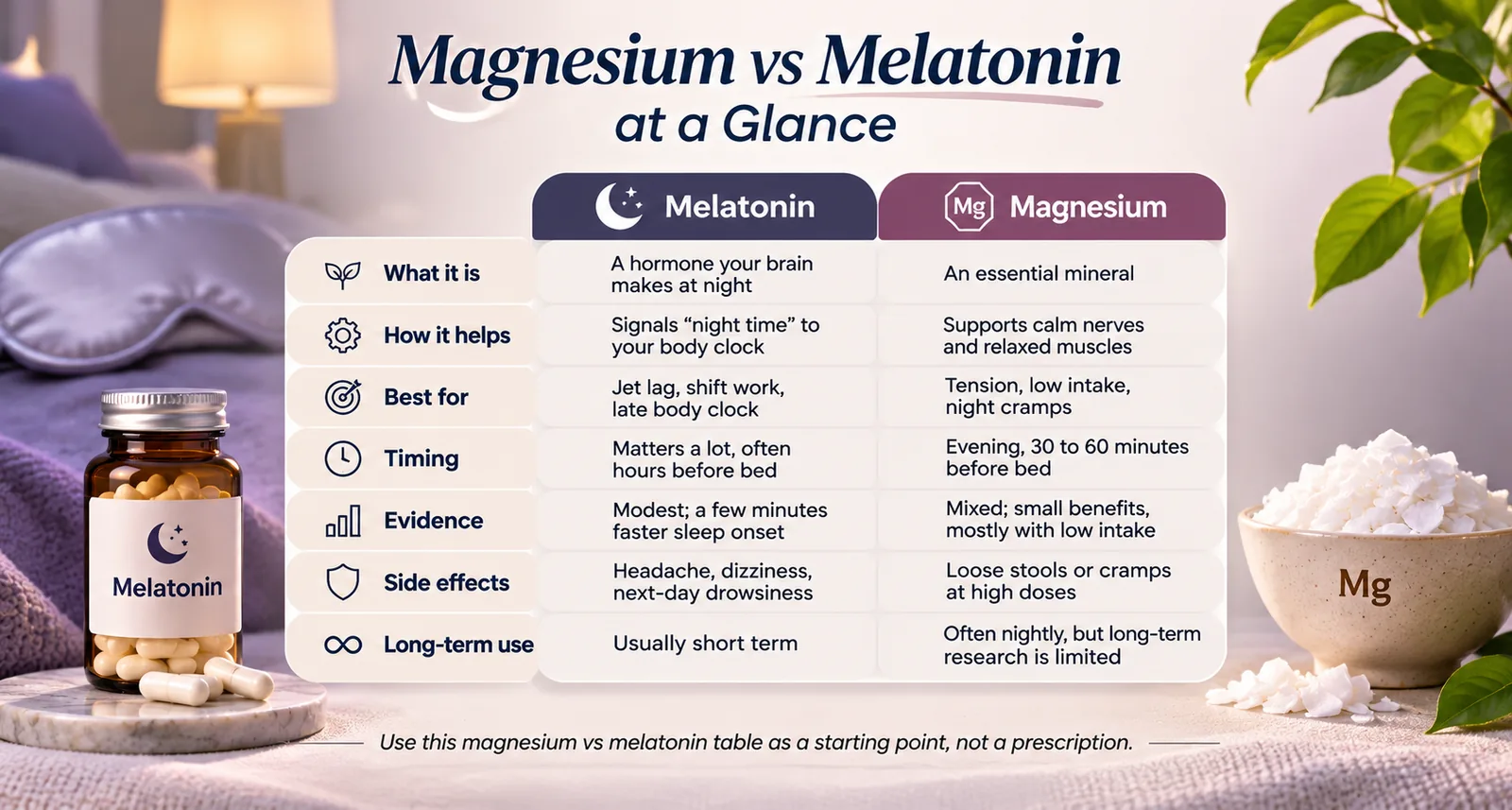
| Melatonin | Magnesium | |
|---|---|---|
| What it is | A hormone your brain makes at night | An essential mineral |
| How it helps | Signals "night time" to your body clock | Supports calm nerves and relaxed muscles |
| Best for | Jet lag, shift work, late body clock | Tension, low intake, night cramps |
| Timing | Matters a lot, often hours before bed | Evening, 30 to 60 minutes before bed |
| Evidence | Modest; a few minutes faster sleep onset | Mixed; small benefits, mostly with low intake |
| Side effects | Headache, dizziness, next-day drowsiness | Loose stools or cramps at high doses |
| Long-term use | Usually short term | Often nightly, but long-term research is limited |
Use this magnesium vs melatonin table as a starting point, not a prescription.
How does melatonin work?
Melatonin is a hormone your brain releases when it gets dark. It is not a sedative. It tells your body clock that night has begun, which is why experts call it a body-clock adjuster rather than a sleeping pill.
That makes timing more important than dose. Taken four to five hours before your usual bedtime, it can nudge your clock earlier. Taken right at bedtime, many people gain only a few minutes, or nothing.
It works best for jet lag, night shifts, and a body clock that runs very late. Analyses suggest it helps people fall asleep roughly 7 to 14 minutes faster. That is real, but small. Experts often suggest low doses of 0.3 to 1 mg for short periods, because more is not better.
Sleep problems rarely come alone. Late, heavy dinners and evening alcohol are common reasons people wake at night. If digestion or liver health is also on your radar, a daily routine such as Liver Biome Plus can sit alongside better evening habits. Many women also notice their sleep shifting around their cycle, which is where a women's health supplement like Ova Balance can fit into a broader routine.
How does magnesium work?
Magnesium is a mineral your nerves and muscles rely on. For sleep, it appears to help in three ways: it supports GABA, a calming messenger in the brain, it helps muscles relax, and it plays a role in your stress response.
It is not a sedative, so its effect is indirect. People who already get enough from food may notice little. Those who run low, or whose sleep is disturbed by muscle tension, have the most to gain. Studies also measure magnesium over weeks, not a single night, which is another difference in the magnesium vs melatonin comparison.
What does the research say? It is encouraging, not conclusive:
- In a 2025 placebo-controlled trial of 155 adults with sleep problems, 250 mg of magnesium bisglycinate daily gave a modest improvement over four weeks.
- A 2024 trial of 80 adults aged 35 to 55 found that magnesium L-threonate improved sleep after three weeks.
- A 2024 review of several trials judged the overall evidence too mixed for firm conclusions.
Think of magnesium as support for relaxation, not a quick fix. If you prefer a non-melatonin route, Mag Absorb Pro combines five magnesium forms with zinc, copper, vitamin B6 and vitamin D3, and is taken in the evening.
Magnesium vs melatonin: which is better for your sleep problem?
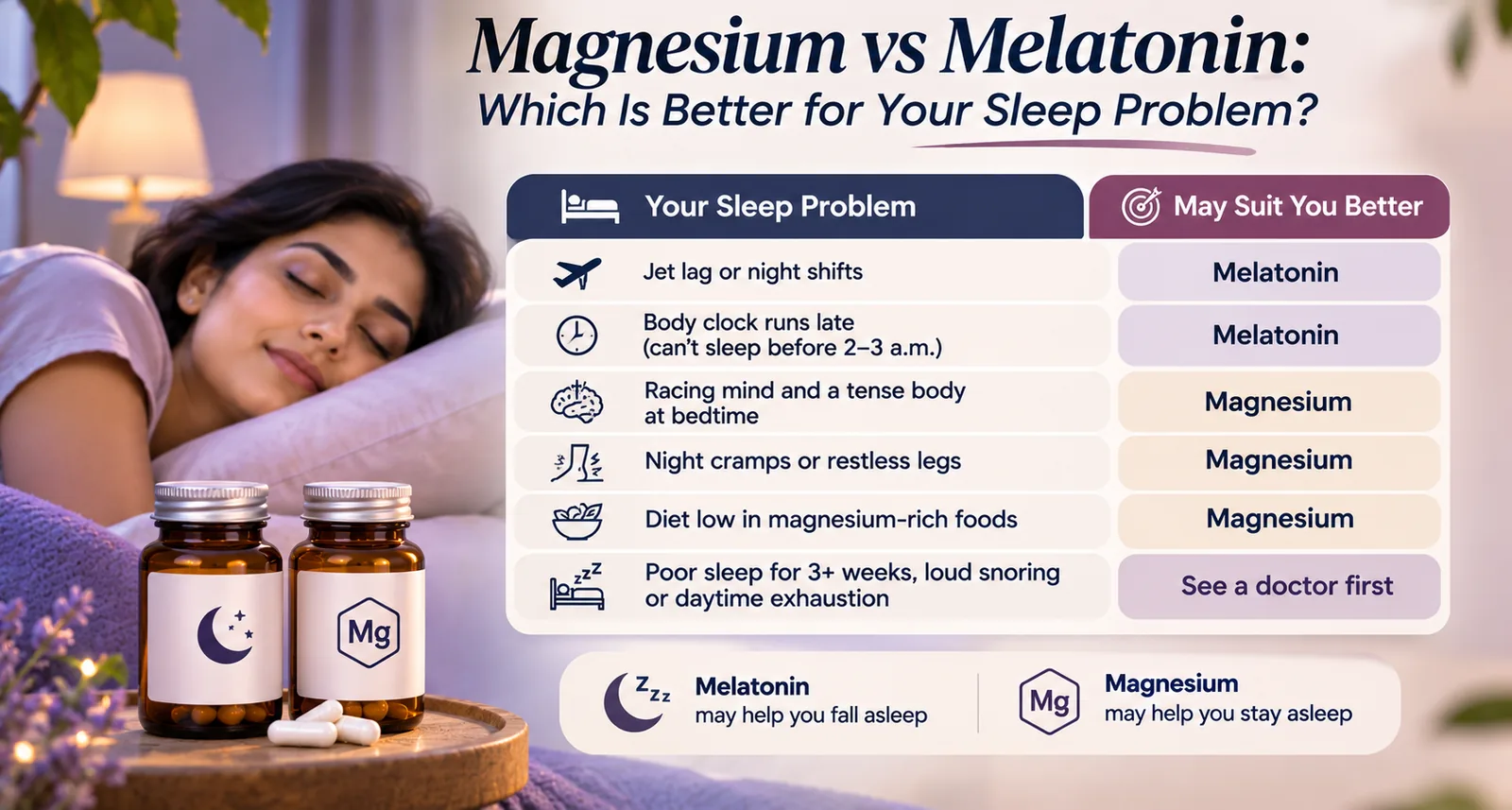
Start with what is actually going wrong at night.
| Your sleep problem | May suit you better |
|---|---|
| Jet lag or night shifts | Melatonin |
| Body clock runs late, you cannot sleep before 2 or 3 a.m. | Melatonin |
| Racing mind and a tense body at bedtime | Magnesium |
| Night cramps or restless legs | Magnesium |
| Diet low in magnesium-rich foods | Magnesium |
| Poor sleep for 3 weeks or more, loud snoring, or daytime exhaustion | See a doctor first |
Some doctors say melatonin tends to help people fall asleep, while magnesium may help them stay asleep. Treat that as a rule of thumb, not a rule. If your sleep schedule, caffeine or screen habits are shaky, fix those first, because you may need neither. Lasting problems can also come from stress, sleep apnea, restless legs, medicines or hormones.
What about magnesium and melatonin taken together?
The two do not seem to interact with each other, and some products combine them. Using melatonin and magnesium for sleep together is common, but common is not the same as proven. A 2019 study of magnesium, melatonin and B vitamins found better insomnia scores after three months. Because three ingredients were involved, nobody can say which one did the work.
If you want to try both, start with one at a low dose, then add the other later so you know what causes any side effect. Check with your doctor first if you take other medicines.
Melatonin, magnesium and zinc for sleep: does the combination make sense?
Zinc is an essential mineral that supports nerve function and immunity. Some small studies link low zinc with poorer sleep, but the research is early, so zinc is not a proven sleep aid. Magnesium and zinc are often paired, yet large amounts can compete for absorption, so more is not better. Long-term high-dose zinc can also lower copper, which is why some formulas, including Mag Absorb Pro, pair zinc with copper.
If you combine melatonin, magnesium and zinc for sleep, add one product at a time and stay within label amounts.
Side effects, interactions and who should be careful
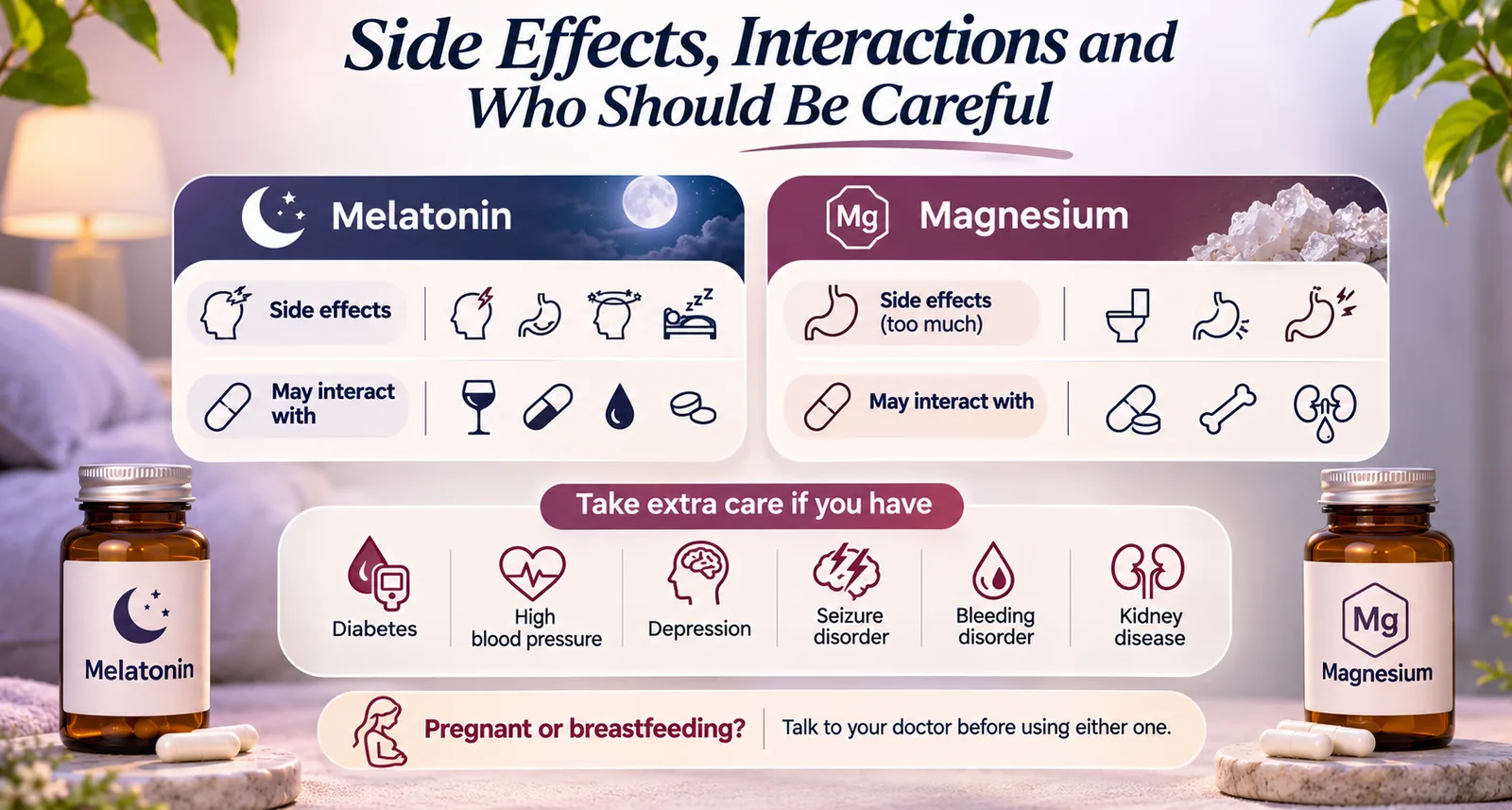
Melatonin can cause headache, nausea, dizziness and next-day drowsiness. It may interact with alcohol, sedatives, opioid painkillers, warfarin and sedating antihistamines. Take extra care if you have diabetes, high blood pressure, depression, or a seizure or bleeding disorder.
Too much magnesium can cause diarrhoea, nausea and stomach cramps. Your kidneys clear the excess, so anyone with kidney disease should ask a doctor first. Magnesium can also reduce the absorption of some antibiotics and bone medicines, and may add to the effect of diuretics. If you are pregnant or breastfeeding, talk to your doctor before using either one.
Magnesium vs melatonin in India: what to know
Magnesium comes from everyday foods such as ragi, pumpkin seeds, almonds, cashews, spinach and rajma. If your meals lean on refined flour and rice, you may be getting less than you think. Late dinners, evening screens, and late-day chai or coffee also hurt sleep, no matter which supplement you pick. Melatonin products vary in strength, so read the label and ask a pharmacist or doctor.
What to look for in a magnesium supplement for sleep
- Form: Bisglycinate is used in sleep trials and tends to be gentler on the stomach than oxide.
- Elemental amount: Check the elemental magnesium per serving, not the total compound weight.
- Timing: Take it in the evening, 30 to 60 minutes before bed, and give it about four weeks.
- Testing: Look for third-party lab testing and FSSAI licensing.
You can compare TruWe's magnesium supplements to see which suits your routine.
How to sleep better without either
Keep the same sleep and wake time daily. Get bright light in the morning. Dim the lights and avoid bright screens for about 90 minutes before bed. Move caffeine and alcohol earlier in the day, and keep your bedroom cool, dark and quiet.
The bottom line
The magnesium vs melatonin question has no single winner. Melatonin is the better tool for timing problems. Magnesium is a gentler option for relaxation, especially if your intake is low. Start with good habits, change one thing at a time, and talk to a doctor if sleep problems last.
FAQs
Q1. Is magnesium or melatonin better for sleep?
It depends on the problem. Melatonin suits timing issues like jet lag and night shifts, while magnesium suits tension or low intake. In the magnesium vs melatonin debate, no head-to-head studies exist, so neither wins outright.
Q2. Can I take magnesium and melatonin together?
They do not seem to interact, and some products combine them, but research on the combination is thin. Start with one, add the other later, and check with your doctor if you take other medicines.
Q3. Does magnesium really help you sleep?
It may help, mostly if you are low in magnesium or feel tense at night. Trials show modest benefits, and reviews call the evidence mixed. Do not expect a sedative effect.
Q4. How long does magnesium take to work for sleep?
Studies measure results over about three to four weeks, so give it at least that long. You may feel more relaxed sooner, but sleep changes usually build gradually.
Q5. How long does melatonin take to work?
Melatonin is not a lights-out pill. Timing matters more than speed: taken hours before bed it may shift your clock, while at bedtime it may add only a few minutes.
Q6. How much magnesium should I take for sleep?
There is no agreed sleep-specific dose. One 2025 trial used 250 mg of magnesium bisglycinate daily. Follow the label, start low, and ask a doctor if you have kidney problems or take regular medicines.
Q7. How much melatonin is safe to take?
There is no universal guideline. Experts often suggest 0.3 to 1 mg for short periods. Higher doses are not clearly better. Ask your doctor before starting, especially for children or if you take other medicines.
Q8. Can I take magnesium every night?
Many people do, within the label amount, and it is a nutrient your body needs daily. Long-term research is limited, so check with your doctor if you have kidney disease or take regular medicines.
Q9. Does magnesium make you drowsy the next day?
It is not a sedative, so next-day drowsiness is not a typical effect. Melatonin is more likely to cause morning grogginess, especially at higher doses. Do not drive if you feel sleepy.
Q10. Who should avoid magnesium and melatonin?
Ask a doctor first if you are pregnant, breastfeeding, have kidney disease, or take sedatives, blood thinners, diuretics or antibiotics. Anyone with ongoing sleep trouble should get checked rather than self-treat.