
Clinical Library · Liver & Gut
Best Probiotic for Gut Health and Digestion
How to pick a probiotic in India without being sold a number — why strain names beat CFU counts, how long it really takes, and where curd fits in.
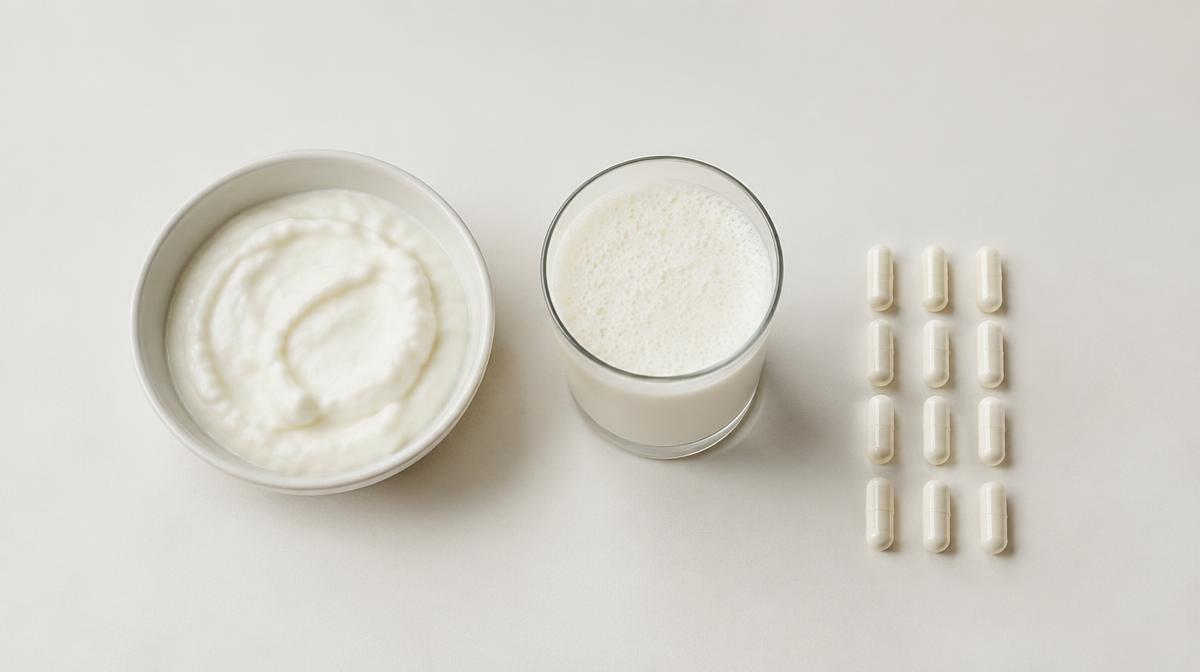
What a probiotic actually does
A probiotic is a live bacterial strain taken in an amount large enough to do something useful. The bacteria already living in your gut help break food down, produce certain vitamins, and keep the intestinal barrier in good order. A probiotic adds specific, characterised strains to that community — it does not replace it.
That distinction explains most of the disappointment people feel. A probiotic supports an existing system; it does not install a new one. If the rest of your nutrition is short on fibre and long on refined food, the strains you swallow have very little to work with.
Strains beat CFU counts
The number on the front of the pack is the easiest thing to inflate and the least informative thing to read. What matters is which strains are in there, and whether they survive the journey.
Lactobacillus acidophilus
One of the most studied strains in the small intestine, long associated with everyday digestive comfort and lactose handling.
Bifidobacterium lactis
A large-intestine resident studied for regularity and for supporting the gut barrier.
Lactobacillus rhamnosus
Among the most researched probiotic strains in the world, with three decades of published work behind it.
Stomach acid is the real obstacle. Unprotected powder loses a large share of its live count on the way down, which is why enteric protection is worth more than an extra twenty billion on the label.
Your five-point label check
- Strains named in full — genus, species, ideally the strain designation too
- CFU count stated at a defined point, not as an at-manufacture number that has faded by the time you buy
- Acid protection, so the strains survive the stomach and arrive where they work
- A storage instruction that matches reality for an Indian summer
- GMP manufacturing and third-party batch testing
Curd, buttermilk and fermented food
Indian nutrition is already rich in fermented food — curd with lunch, a glass of chaas, idli and dosa batter, pickles, kanji in winter. None of that should go. Fermented food brings variety, and variety is good for a microbiome.
What fermented food cannot do is guarantee a particular strain at a particular count on a particular day. Curd varies by batch, brand and season. A capsule exists for exactly that reason: it makes the dose predictable. Use both — food for variety, a supplement for consistency.
Bloating, regularity and what to expect
Most people who notice a change notice it in the second to fourth week: meals sitting more comfortably, a steadier rhythm. Mild gas in the first few days is common and usually settles as your gut adjusts.
If bloating is your main complaint, read our guide to bloating after meals first — eating speed, lactose, fibre changes and stress explain a great deal of it, and a probiotic works better once those are addressed.
Four things people get told that are not quite right
“More CFU means a better probiotic”
Survival and strain identity decide the outcome. A named, protected 10 billion CFU formula can outperform an unnamed 50 billion one.
“You should feel it in two days”
Two to four weeks is a realistic first checkpoint, and eight weeks before you judge it.
“Probiotics replace fibre”
They work alongside it. Fibre from dals, vegetables, fruit and whole grains is what feeds the bacteria you already have.
“Every probiotic does the same job”
Different strains are studied for different outcomes. The label should tell you which ones you are getting.
The gut-liver connection most probiotics ignore
Around 70% of the blood reaching your liver arrives from the gut. That makes gut barrier health a liver question as much as a digestion question — the gut-liver axis explainer walks through how the two are wired together.
It is also why our own formula pairs the probiotic with liver actives rather than selling it alone. Liver Biome Plus carries an enteric-protected 10 billion CFU blend of L. acidophilus, B. lactis and L. rhamnosus alongside NAC, liposomal silymarin, liposomal curcumin and alpha-lipoic acid — one serving a day, every amount printed on the pack.
Frequently asked questions
What is the best probiotic for digestion?
The best probiotic for digestion is one that names its strains, states the CFU count, and protects those strains from stomach acid so they arrive alive. Lactobacillus acidophilus, Bifidobacterium lactis and Lactobacillus rhamnosus are among the most studied for everyday digestive comfort.
Is a higher CFU count better?
Not on its own. A 50 billion CFU product with unnamed strains and no acid protection can deliver less than a 10 billion CFU product that names its strains and protects them. Strain identity and survival matter more than the number on the front.
How long does a probiotic take to work?
Most people who notice anything notice it within two to four weeks of daily use. Give it a full eight weeks before deciding, and keep the rest of your nutrition steady so you can actually tell what changed.
Should I take a probiotic in the morning or at night?
Either works. What matters far more is taking it at the same time every day, with a meal, so it becomes a habit rather than an occasional thing.
Is curd enough, or do I need a capsule?
Curd, buttermilk, idli and dosa batters, and other fermented foods are genuinely good for you and should stay in your nutrition. What they cannot do is deliver a known strain at a known count every single day, which is the one thing a capsule is designed for.
Can probiotics help with bloating?
They are studied for digestive comfort and regularity, and many people find bloating settles as their routine steadies. Bloating has many causes though — eating speed, fibre, lactose, stress and meal timing among them — so treat a probiotic as one part of the picture.
Who should be careful with probiotics?
Anyone who is severely immunocompromised, critically ill, or recovering from major surgery should take probiotics only under medical advice. Mild gas in the first few days is common and usually settles.
Can I take a probiotic with antibiotics?
Many people do, usually spacing the two a couple of hours apart, but this is a question for the doctor who prescribed the antibiotic rather than for a label.
The formulation behind this article
Liver Biome Plus
Liposomal liver actives + a targeted gut biome stack
N-Acetyl Cysteine (NAC)
600 mgForm used: N-acetyl cysteine, 600 mg (standard, non-liposomal)
Direct precursor to glutathione, the body's master antioxidant. The clinical standard for liver protection and Phase II detox.
Liposomal Milk Thistle (Silymarin)
350 mg EqForm used: Liposomal silymarin, 350 mg equivalent
Liposomal silymarin (350 mg equivalent), helps stabilise hepatocyte membranes and supports bile flow and hepatic resilience.
Liposomal Curcumin
100 mgForm used: Liposomal curcumin, 100 mg
Phospholipid-encapsulated curcumin (100 mg), helps support a healthy inflammation response, with markedly higher plasma exposure than plain powder.
Liposomal Alpha-Lipoic Acid
100 mgForm used: Liposomal alpha-lipoic acid, 100 mg
The 'universal antioxidant' both water- and fat-soluble. Recycles vitamins C, E and glutathione.
Probiotic Blend (10B CFU)
10 Billion CFUForm used: Enteric-protected multi-strain consortium, 10 billion CFU
Multi-strain L. acidophilus, B. lactis, L. rhamnosus, for gut barrier integrity and microbial diversity.
Food supplement, not a medicine. Ingredient research describes individual actives and their delivery forms, not finished-product outcomes. Consult a clinician if pregnant, lactating or on prescription medication.
Educational only. This article does not diagnose or treat any digestive condition. Speak with a qualified clinician before starting a supplement, especially if you are immunocompromised, taking prescription medication, or pregnant or breastfeeding.